A REVIEW OF JEFF HOWELL’S BOOK
‘THE RISING DAMP MYTH’
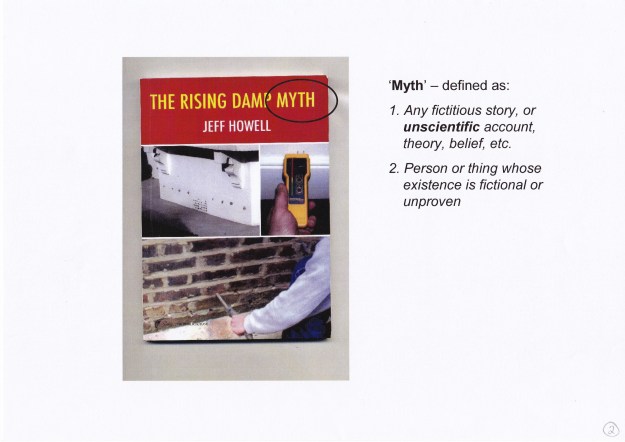
From ‘The Rising Damp Myth’ by Jeff Howell
“For the fact that rising damp is a mythical building defect, which only came to widespread prominence in the 1960s—-“
“The rising damp myth has become so powerful, and so deeply ingrained in the psyche of the construction professions, that you question it is to invite denial and even ridicule.”
Some recent quotes:
Architects Journal 2009:
“Rising damp is as rare as a rocking horse s**t!!”
Elaine Blackett-Ord, Blackett_Ord Conservation Architects, Cumbria: also chair of the Register of Architects Accredited in Building Conservation
Architects Journal 2009:
“Stephen Boniface, former chairman of the construction arm of the Royal Institution of Chartered Surveyors (RICS), has told the institute’s 40,000 members that ‘true rising damp’ is a myth and chemically injected damp-proof courses (DPC) are “complete waste of money”.
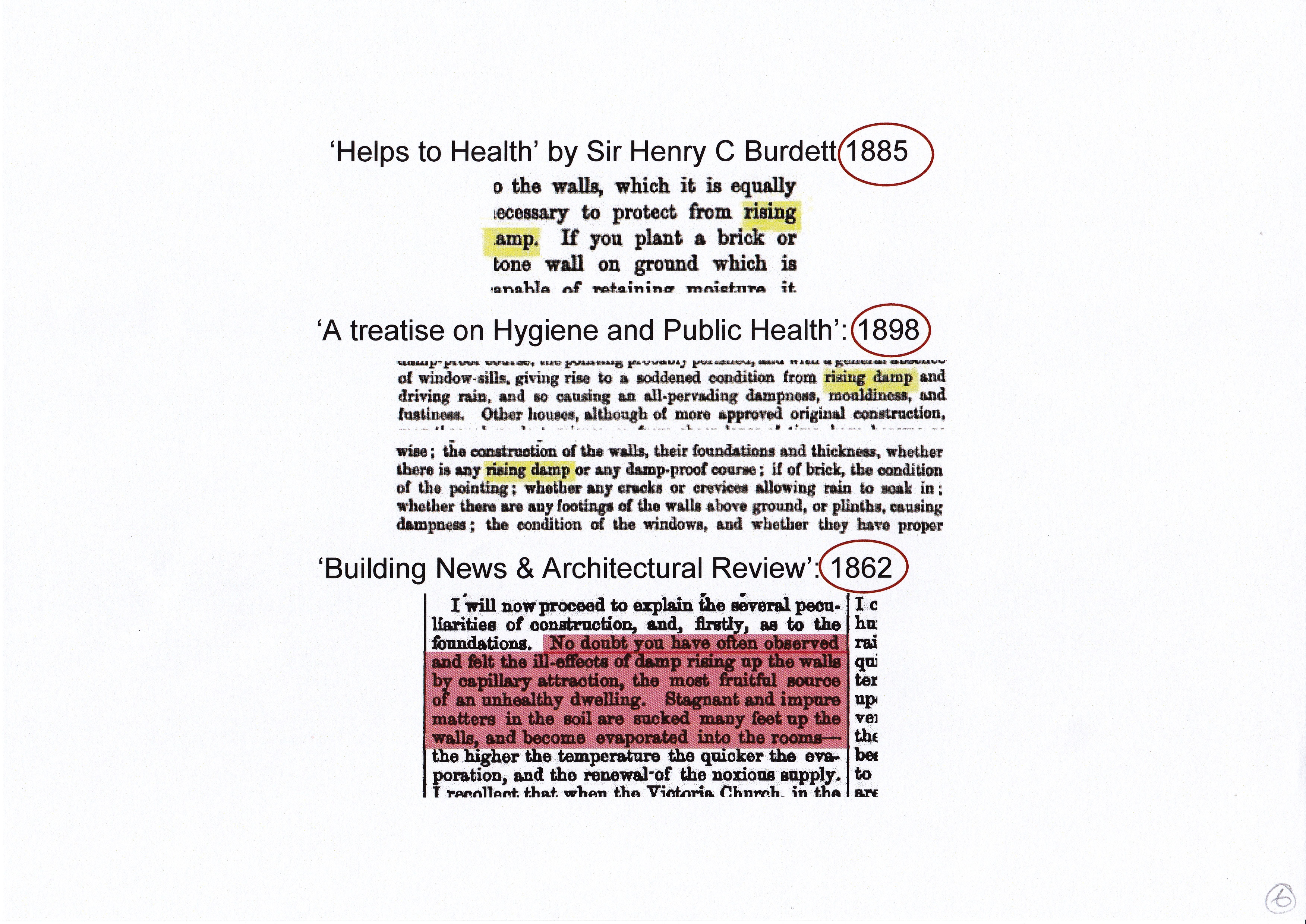
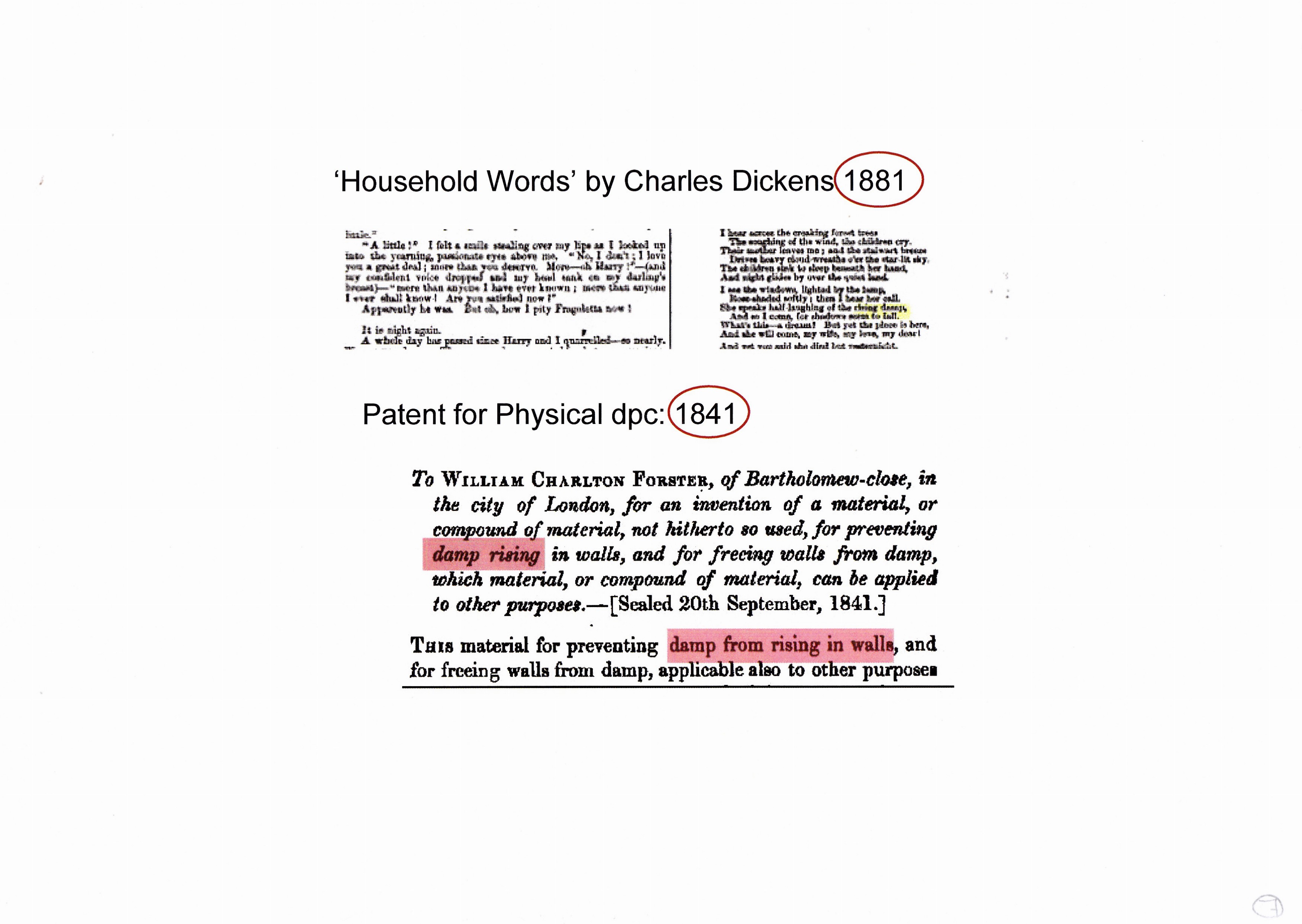
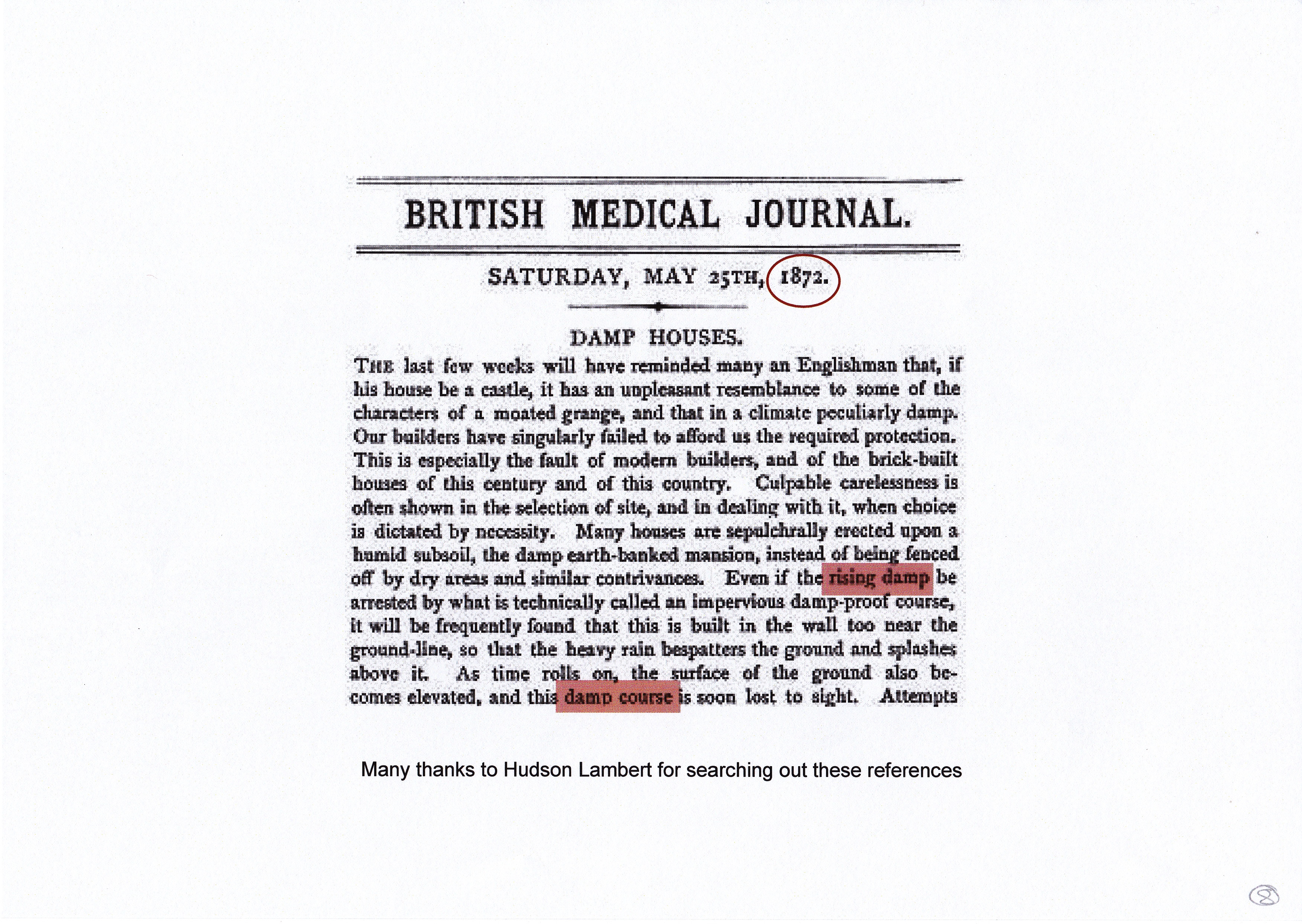
THE ORIGIN OF THE TERM ‘RISING DAMP’
In the book ‘The rising Damp Myth’ the author states,
“The earliest use of the phrase “rising damp” that I could find in official literature was from 1951 —“
However:-
Transactions of the Royal Institute of British Architects 1862-3
“The dry rot which had once required all the timbers to be removed, and was now again destroying them, will be prevented by the circulation of air, and the house will be as free from rising damp as if upon a gravel soil”
(from a paper on damp-proof courses and dampness in buildings)
RISING DAMP
We could define rising damp as:
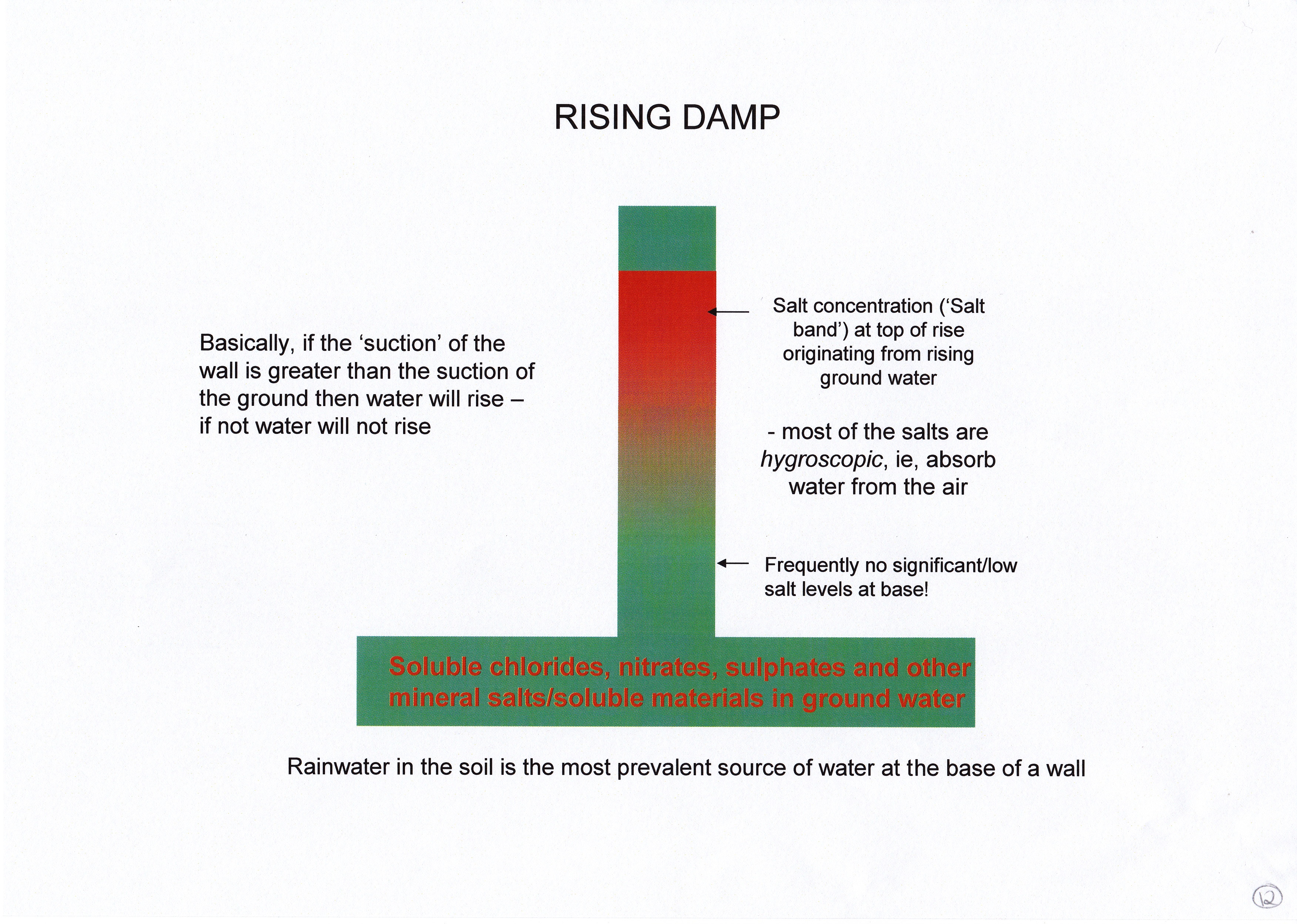
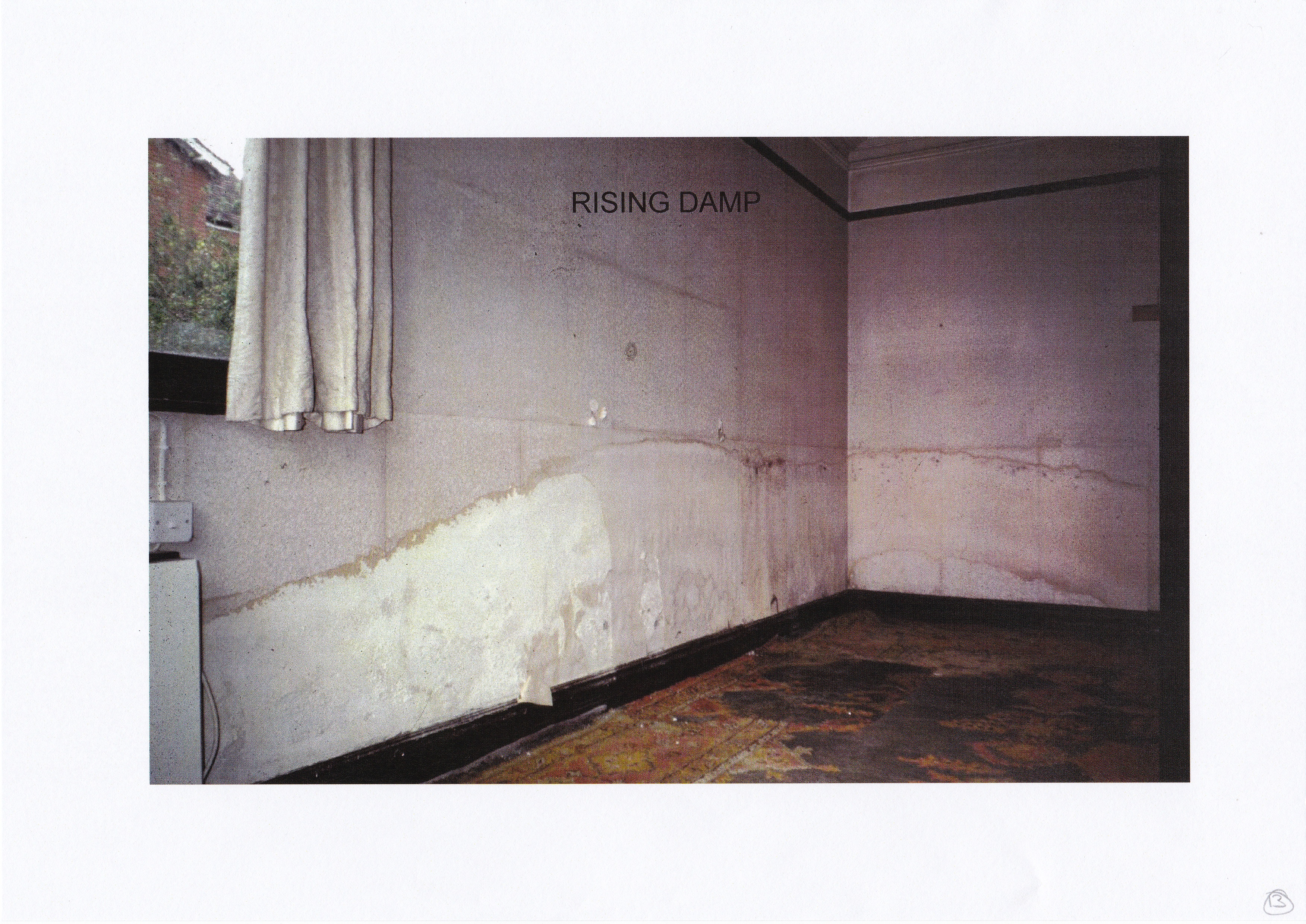
The vertical movement of water up through masonry, the water originating from ground water. The water rises up through a series of interconnecting pores by a process called ‘capillarity’ – broadly, porous masonry acts like a ‘wick’.
Note: The rise of liquids from roots to leaves in plants is a process knows as ‘cohesion’ (‘transpiration pull’), not simple capillarity, and involves hydrogen bonding of water.
Rise of liquids in plants is NOT simple capillarity as indicated in the book ‘The Rising Damp Myth’!!
(Also his calculations and decimal points for heights of rise are wrong!)
RISING DAMP
Ground water contains a proportion of soluble materials, both organic and inorganic.
Of the dissolved soluble inorganic materials the most prevalent are:
Chlorides
Nitrates
Sulphates
Most building materials are, for practical purposes, free of chloride and nitrate (<0.01% – such levels are of no consequence). However, sulphates can be present naturally at much higher levels.
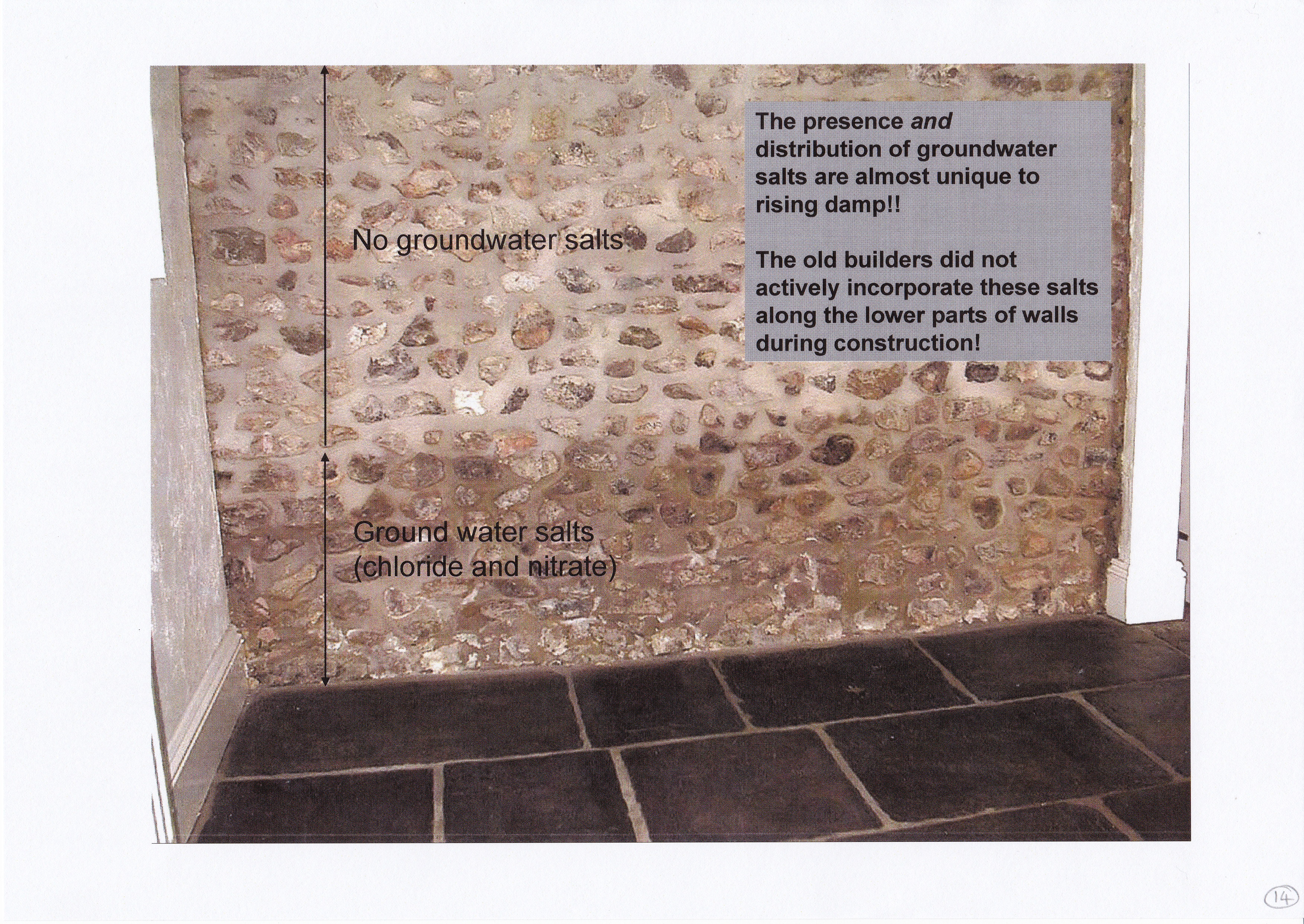
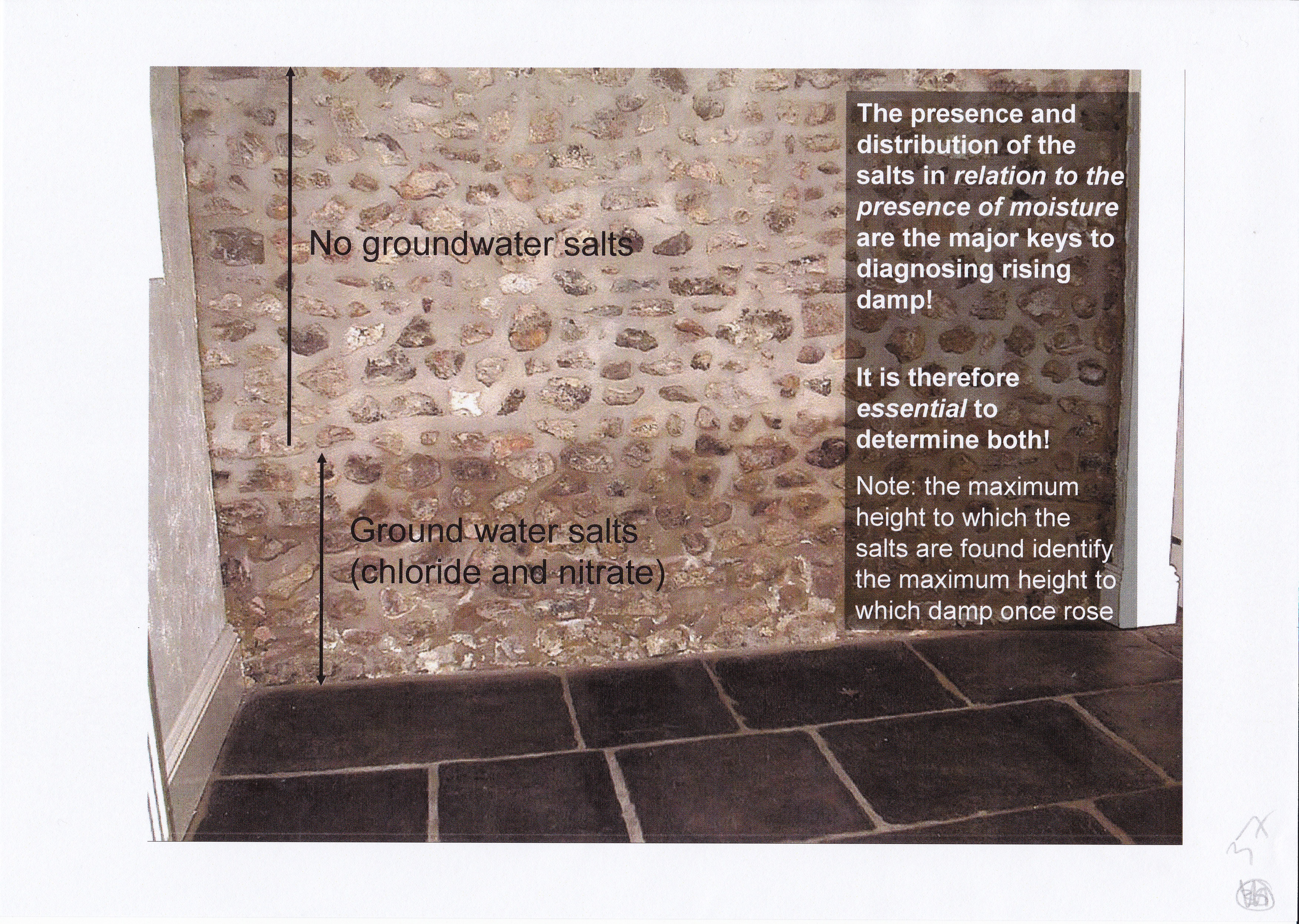
So if soluble chloride and nitrate are present at readily identifiable levels they must have originated from some source.

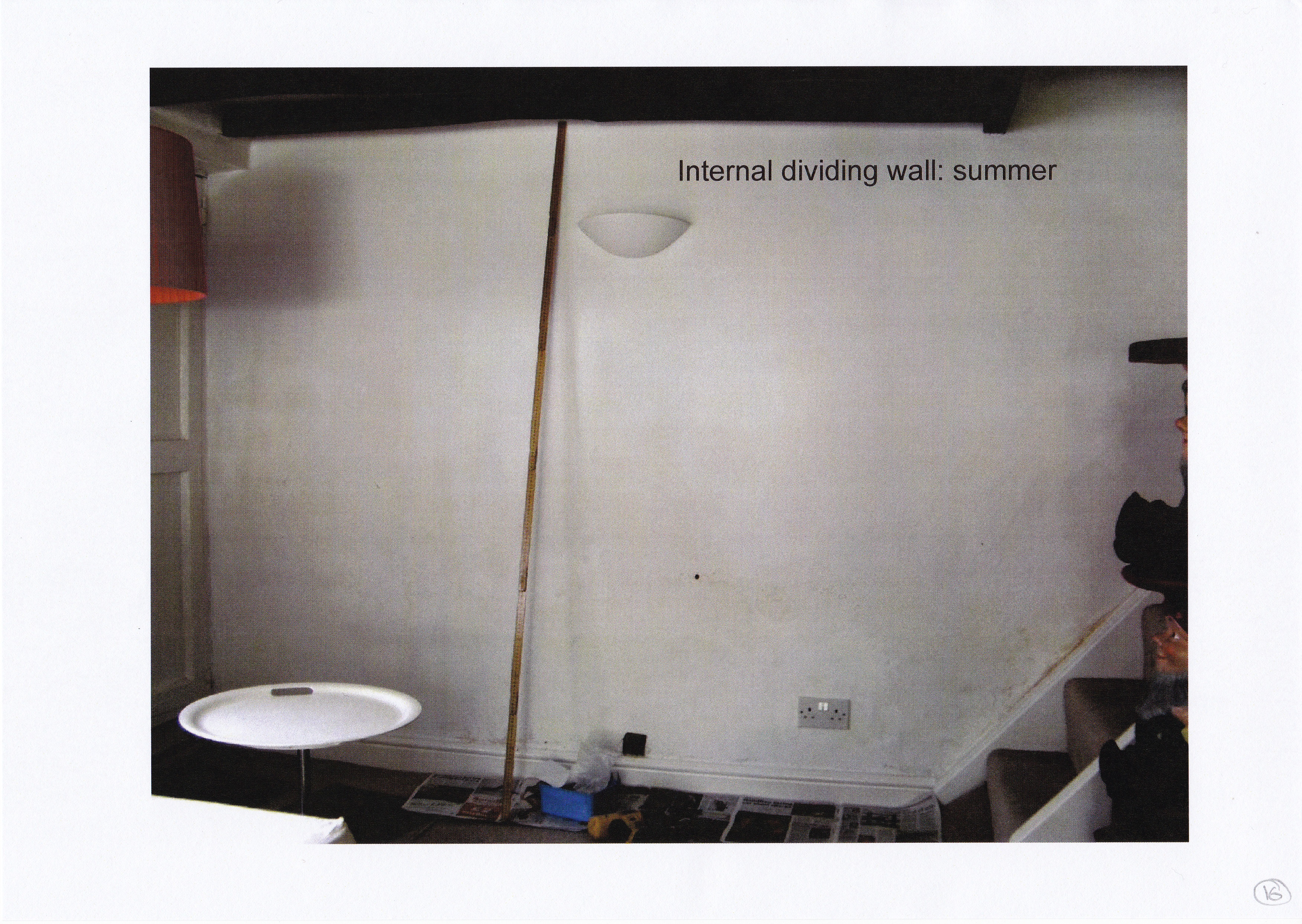

HEIGHT OF RISE
One major factor in rise is pore diameter. Pore size in bricks/mortar can be as small as 0.001mm radius
Average size is around 0.01mm radius
A pore size of 0.01,, radius gives a theoretical height rise or around 1.5m!
Thus rising damp can rise WELL in excess of 1m, the height frequently claimed to be the maximum!
RISING DAMP
It must be fully appreciated that no walls without a physical damp-proof course will be subject to rising damp!
Therefore taking an old wall and immersing it in water will not prove or disprove the existing of rising damp as implied in ‘The rising damp myth’!
Similarly, structures built into water may not have rising damp; again, no ‘proof’ that rising damp doesn’t exist as some suggest.
LABORATORY SIMULATION IF RISING DAMP
Architect Journal 2009:
“Jeff Howell, a qualified bricklayer and author of ‘The Rising Damp Myth’ (2008) said trails in the laboratory [1993-96] confirm the falsehood [RISING DAMP]. If you build a brick pillar and stand it in a tray of water, the bricks in the water will get wet, but the water doesn’t rise by capillary action, ‘ said Howell. ‘Cement-based and most lime-based mortars will not allow water to go through.’”
BUT Letter from Jeff Howell to one sponsor in 1994:
“ In the foreground are two pillars of ibstock Red Leicester facing bricks (14% porosity) which are nicely wet up to five courses, and starting to show a pattern of efflorescence at the evaporative surface. Behind then two pillars of LBC Flettons, not so damp but, interestingly, the mortar is visibly damp up to the sixth course.”
— and Jeff Howell to sponsor in 1995:
“This wall had been standing in water for eight months, and had some hygroscopic salt contamination. It had rising damp which was visible up to a level of approximately 500 mm (six courses). It therefore represented a typical rising damp complex.”
(If it was “typical”: then, by definition, it was “characteristic/representative” of a commonly observed phenomenon, ie, it is well recorded and therefore he must have GOOD experience of it!)
On Howell’s quote:
‘Cement-based and most lime-based mortars will not allow water to go through.’
This is partly true for fresh, uncarbonated materials – but not for 80+year old materials – their permeability changes: it also depends of the strength of the mortar mix. (However, note that recently applied cement renders following dpc installation can fail in a short time, ie, let water and salts through!! Old and moderately recently lime mortars are distinctly permeable)
Cement/lime mixes in the laboratory cannot readily be aged to replicate the physical properties of the old materials – therefore the tests need to simulate the old materials!
MOISTURE METERS
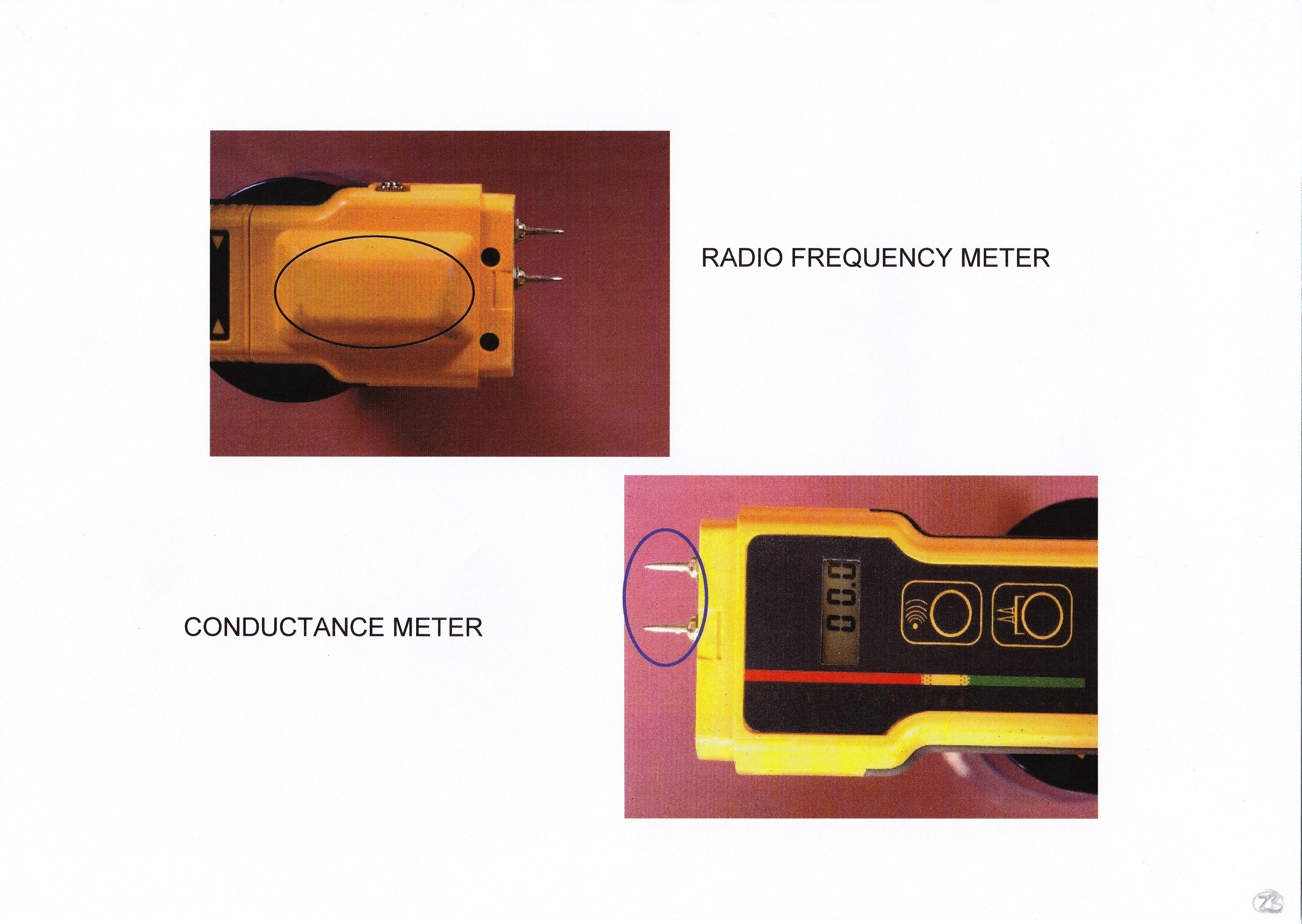
IMPORTANT!
When used on a masonry substrate Electrical Moisture Meters:
- Do NOT record % moisture
- Do NOT record % saturation
They record a relative reading NOT directly proportional to quantity – ie, their response is non-linear
– they are purely QUALITATIVE!!
IMPORTANT!
Conductance meters do not respond to any significance on most clean, uncontaminated inorganic materials in their air dry state even under conditions of high humidity, eg, brick, mortar, concrete, paint, wallpaper paste!! There are very few exceptions!
Different materials have different ‘air dry’ moisture contents; most are not significantly hygroscopic and will absorb only very little extra moisture with increase in humidity; this does not significantly affect meter readings as claimed in the ‘Rising damp myth’
Air dry moisture contents of some materials:
Brick: 0.1 – 1.0%
Gypsum plasters 0.5 – 1.0%
Old lime plasters up to 2.0%
Cement renders up to 2.0% (appears to depend on carbonation)
Wood (organic – hygroscopic!) max of 16 – 17% in a ‘dry’ environment
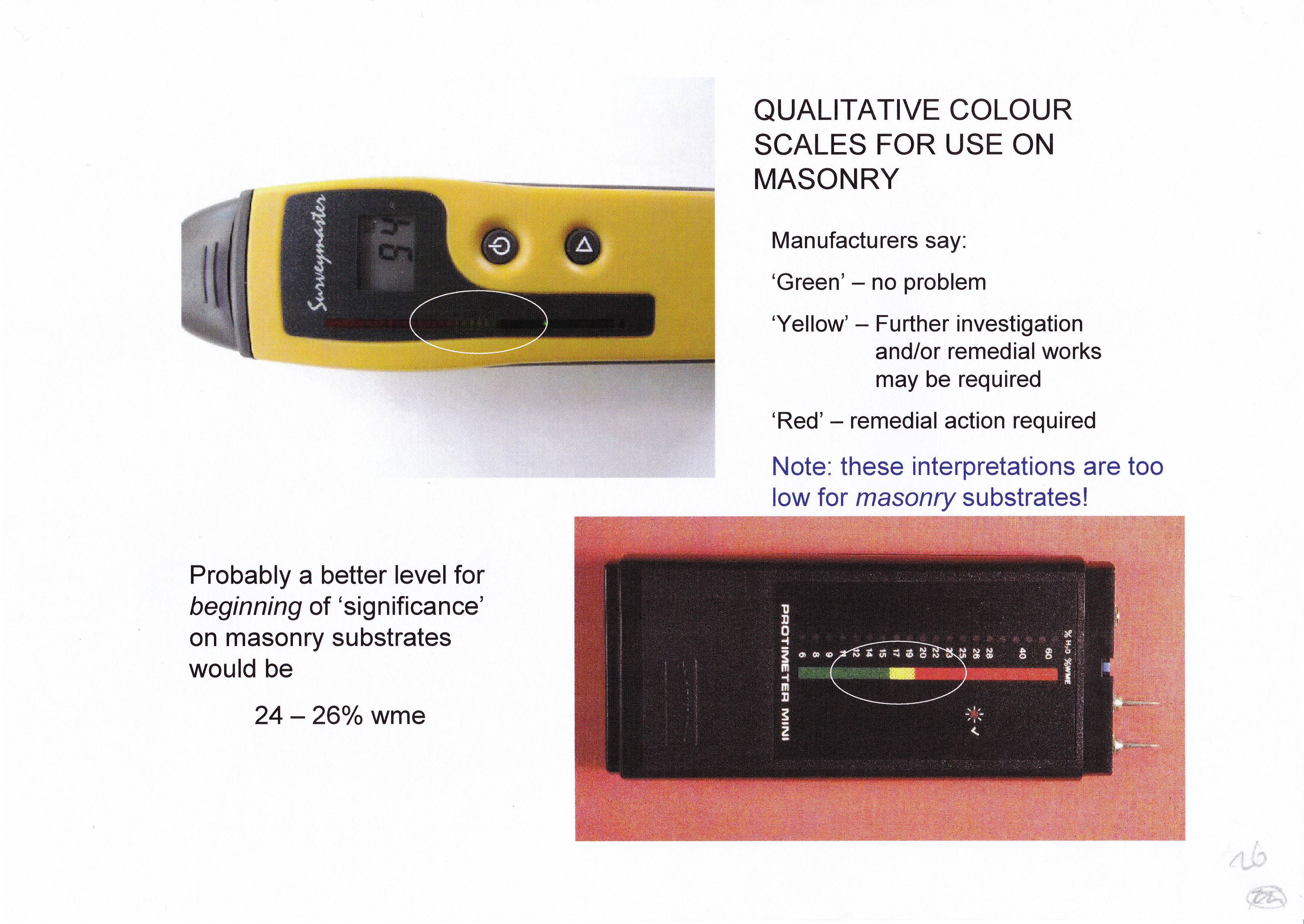
PROBLEMS WITH ELECTRICAL
MOISTURE METERS
They are too sensitive and it takes skill to interpret results
Erroneous results can be obtained by:
- Contaminated salts, ie, hygroscopic salts only!
- Some materials containing carbon or other electrically conducting material (rare and local knowledge)
- Foil backed paper (experience)
- Surveyor’s fingers on the probes!!!
BUT over 99% of high figures will be the result of water and/or hygroscopic salts, neither of which should be in the masonry and must have therefore arisen from somewhere!
In the book ‘The Rising Damp Myth’ it is reported that one RICS Surveyor’s notes state, inter alia, the following:
“Older properties tend to have an accumulation of surfaces salts due to years of evaporation. These salts, whether hygroscopic or not, will lead to readings on a protimeter a zone or two higher than the actual amount of water present.”
BUT
- Only hygroscopic salts will cause high readings. Efflorescent salts alone in an air dry substrate DO NOT!!!
- Where did the water come from to result in “years of evaporation”??
- Only a very few building material will cause an electrical conductivity meter to respond significantly in the absence of free water and/or hygroscopic salts!
- Over 30 years of sampling experience has shown that this reported ‘natural’ surface salt problems is not the case.
DIAGNOSING RISING DAMP
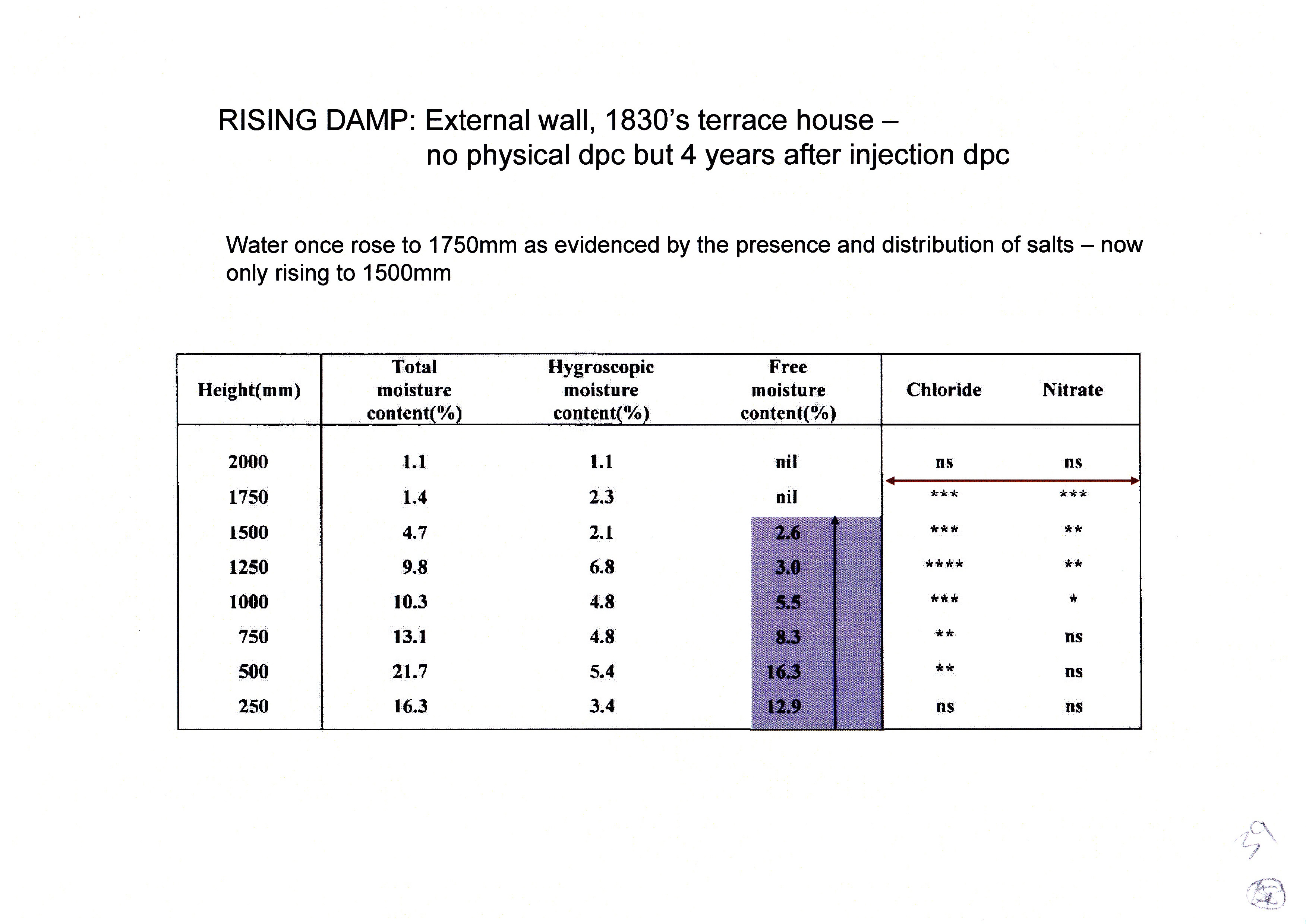
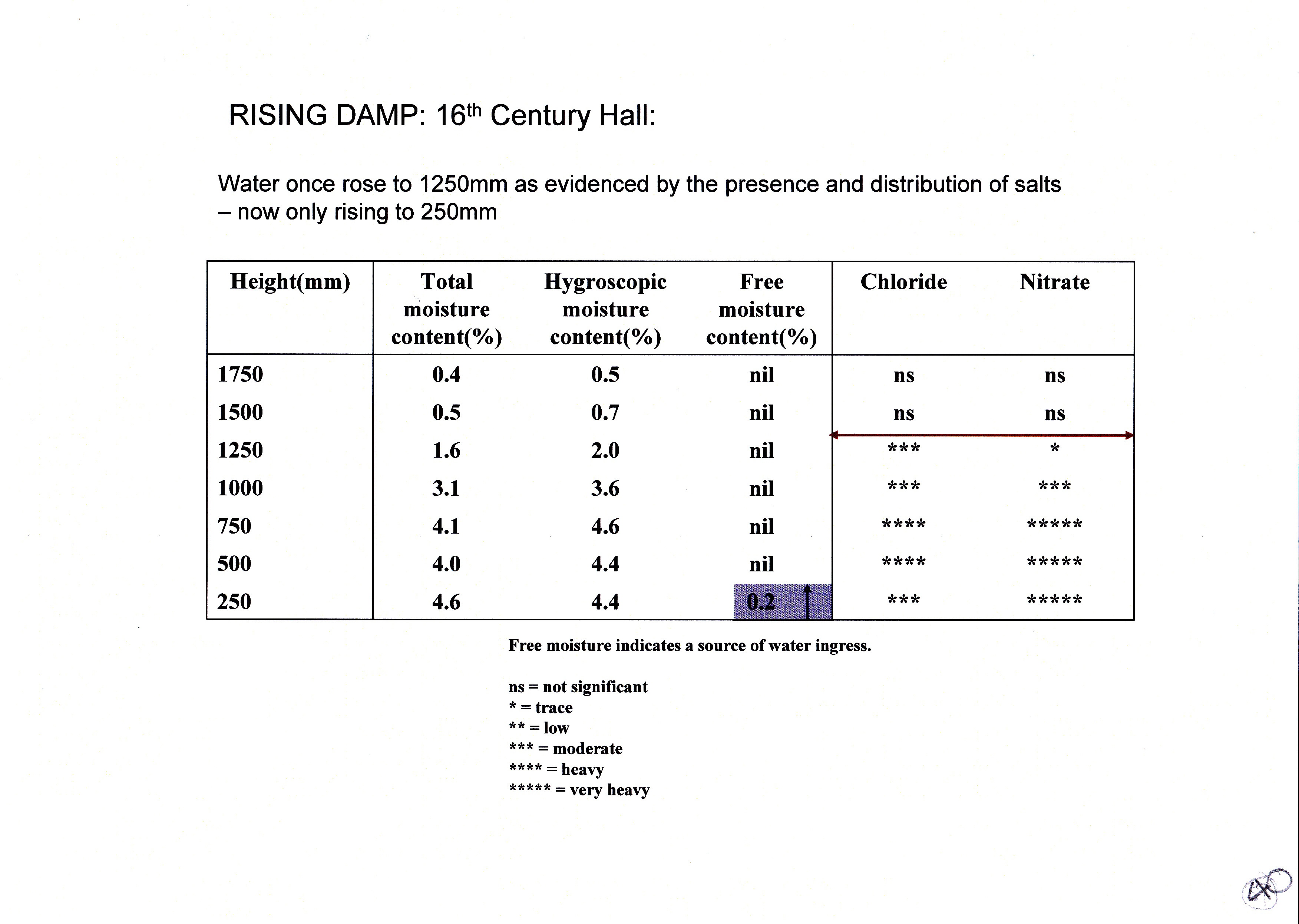
TOTAL MOISTURE CONTENT
of brick/mortar/plaster, etc, is potentially
the sum of 2 components:
- AIR DRY (HYGROSCOPIC MOISTURE CONTENT
Moisture in a material when it is in equilibrium with the air. It is what we
would regard as a ‘dry’ material, ie, when there is no water ingress. It is a
material’s ‘standing’ level of moisture.
- CAPILLARY (OR FREE) MOISTURE CONTENT
Moisture that fills the capillaries of the material. It is only present what there
is an active source of water ingress, eg, rising damp, water penetration, etc.
It is this water that usually causes problems.
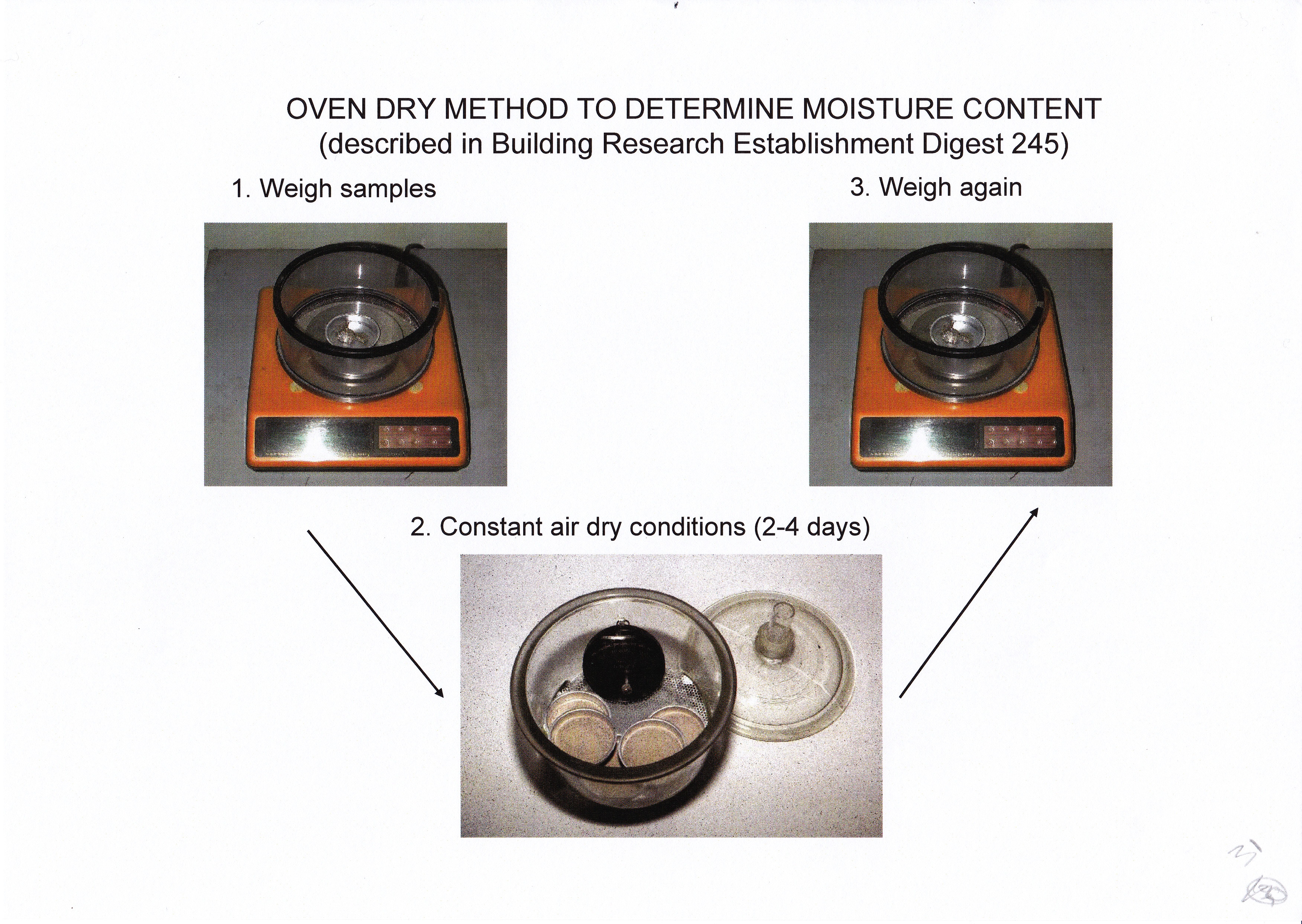
Principal:
If the sample loses weight it has dried out
ie, it contained capillar (free) moisture and therefore it was subject to a source of water ingress at the time of its removal
If the sample does not change in weight (or gains) it was ‘dry’ (not subject to water ingress) at the time of its removal.
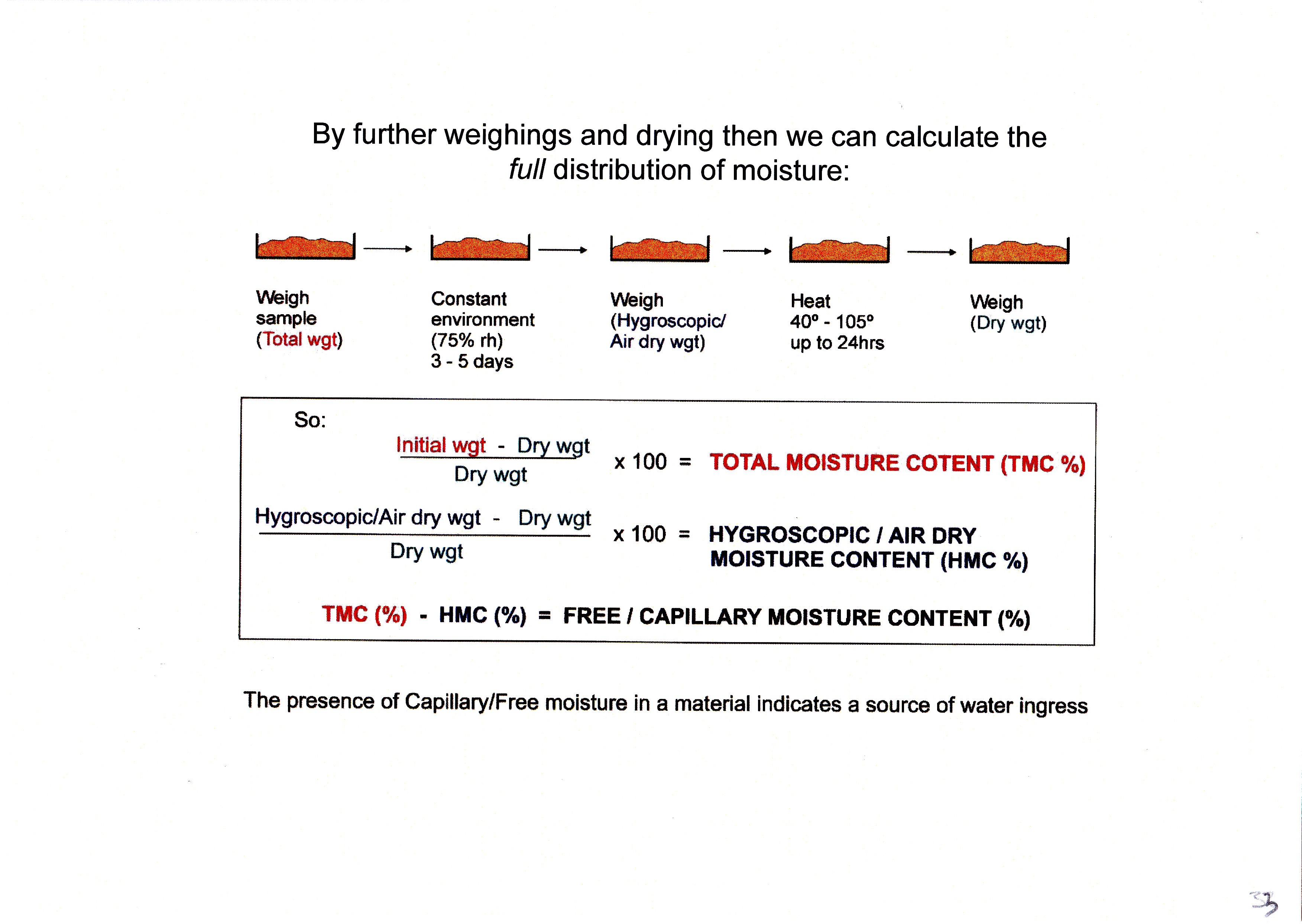
Note: the method basically identifies the presence of water ingress, or not –
it does not necessarily, on its own, identify specifically rising damp-and certainly not from a single sample!
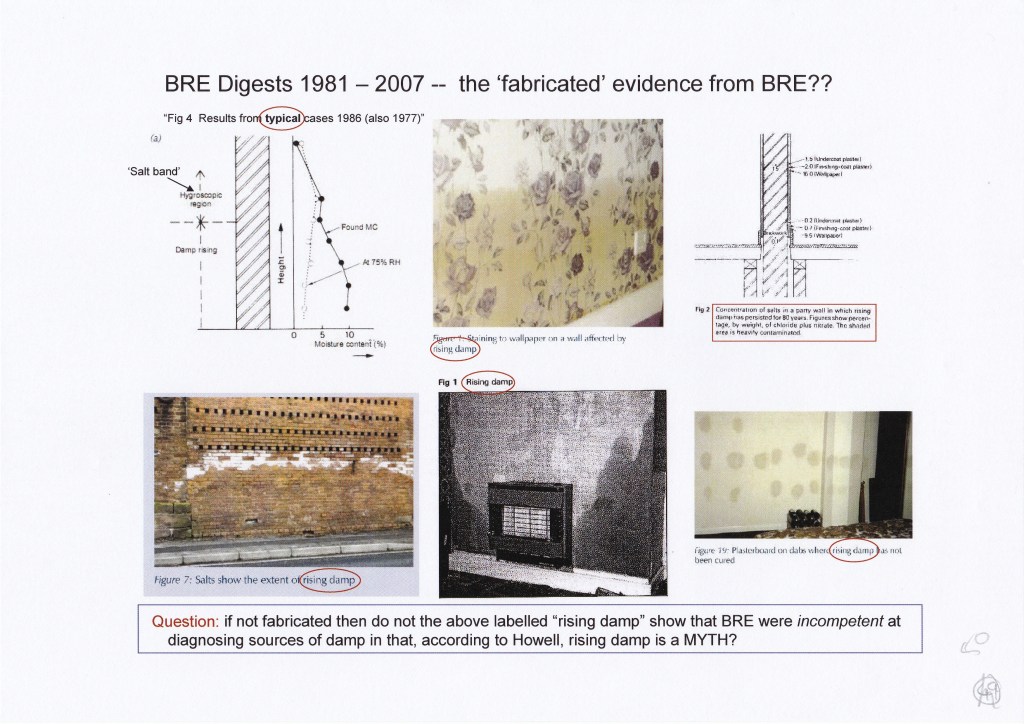
The author explains the Building Research establishment Digest 245* method in ‘The Rising Damp Myth’ but he has completely misunderstood how the results are interpreted!
He states that if the sample gains weight then:
“— it was contaminated with salts (and therefore possibly affected by ground water)”
(Note: could “ground water” and salts be from the ‘mythical rising damp’??)
If it loses weight the:
“–it’s moisture content was more likely due to a non-salt contaminated moisture source, such as rainwater or condensation”
The above interpretations are WRONG! For example, if the sample loses weight it simply shows that it was subject to water ingress FROM SOME SOURCE, eg, water penetration, rising damp. If it gains then it was ‘dry’ (no water ingress) and removed from a relative humidity lower than that of the test – it does no necessarily reflect salt contamination!
This could explain why the Author has never found rising damp (and never would on his interpretation), and begs the question, has he ever used the method??
*BRE Digest 245: ‘Rising Damp in Walls: Diagnosis and Treatment’
THE GROUNDWATER SALTS
(HYGROSCOPIC SALTS)
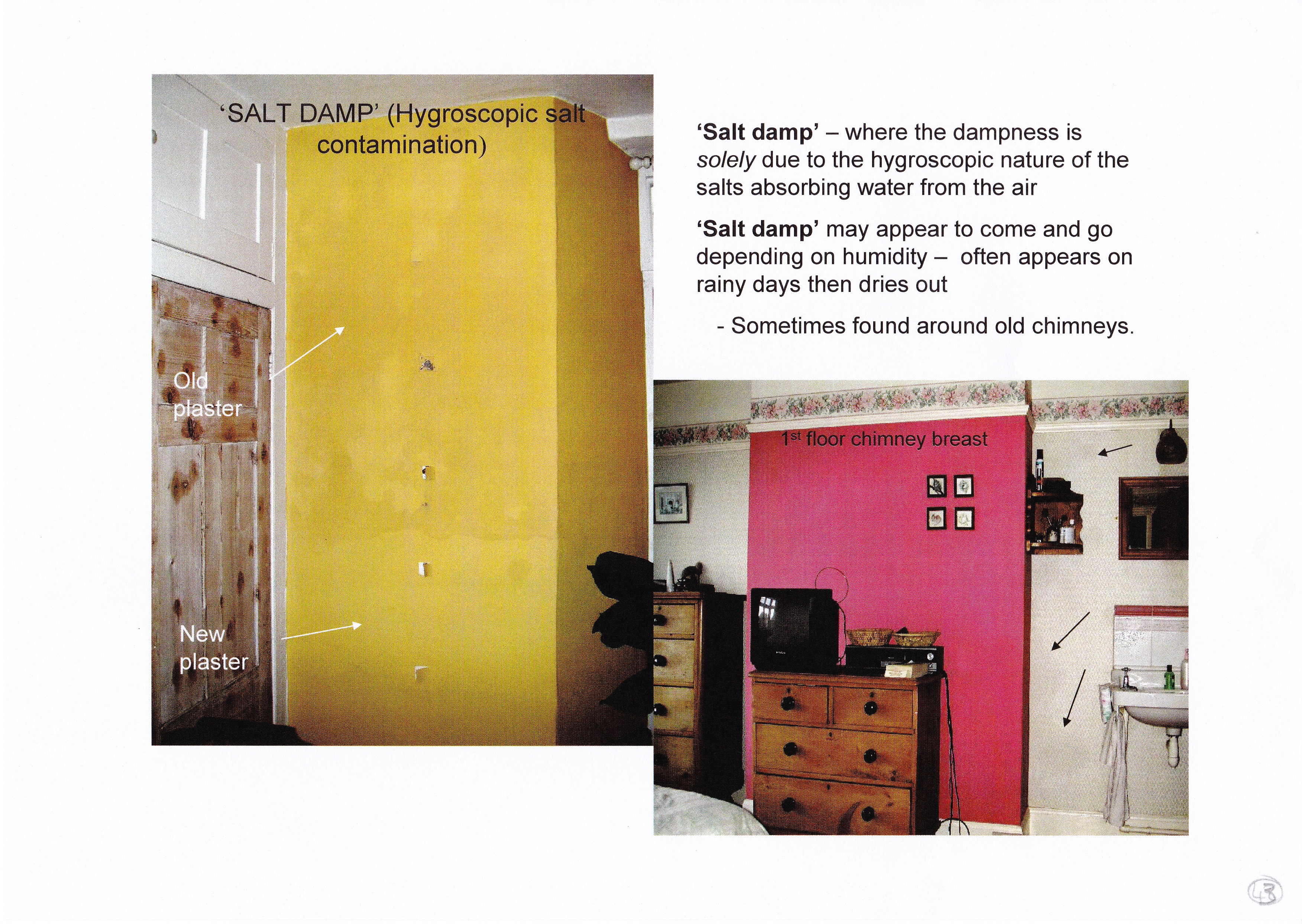
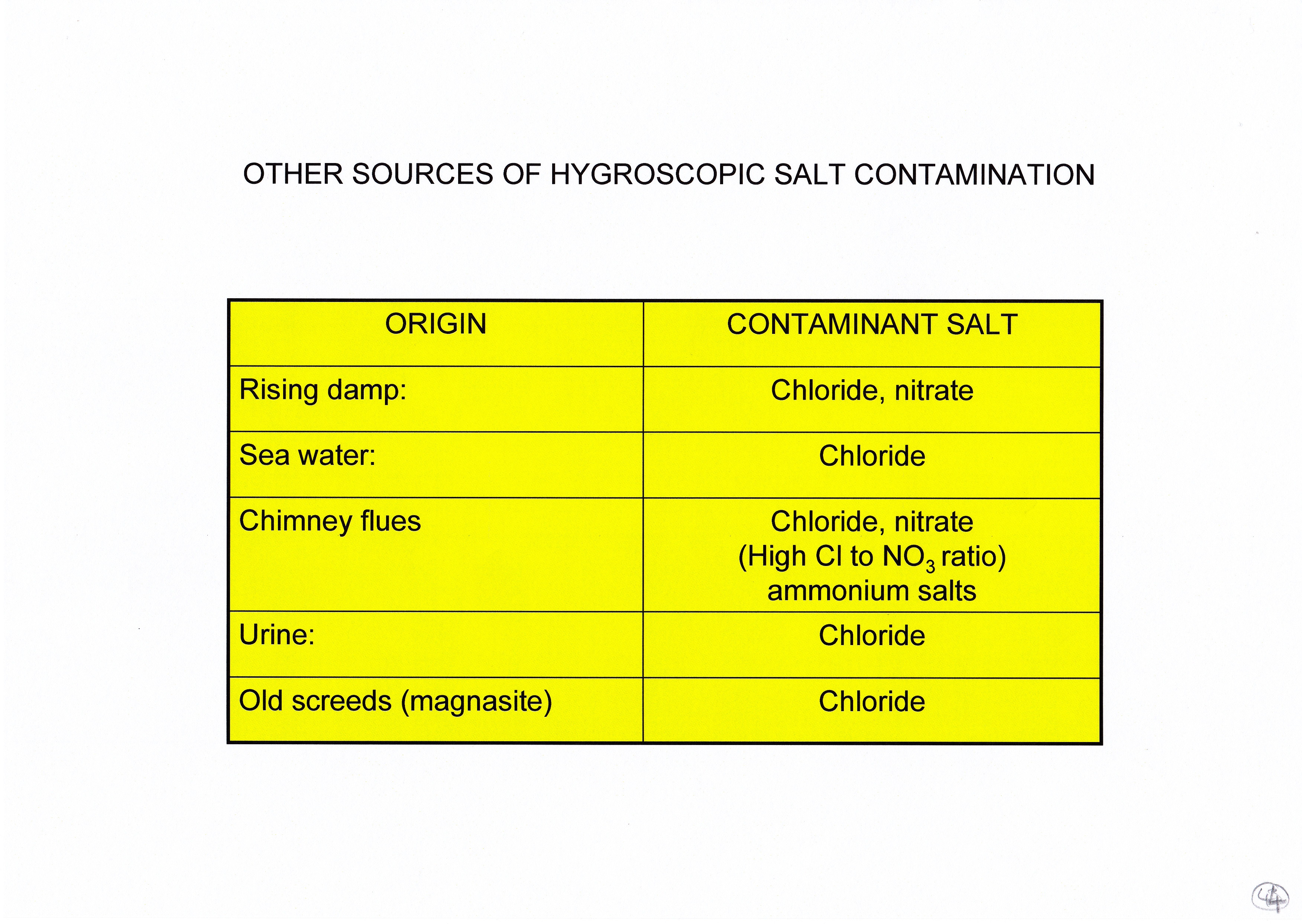
Hygroscopic salts absorb water from the air
- They are rarely seen on surfaces BUT their effects are on the form of visible dampness/high surface moisture meter readings.
- Their most common origin is rising damp, and sometimes around old chimney flues where they arise from the long tern combustion of fossil fuels
Hygroscopic salts are frequently referred to by those who state rising damp is a myth, and blame these salts, in part, for misdiagnosis or rising damp using moisture meters.
– but given that almost all building materials are effectively free from such salts, those that support the ‘myth’ never seem to explain how they only contaminate and are distributed in the lower parts of the walls!
MANIPULATING THE MYTH
Jeff Howell in ‘The Rising Damp Myth’ quotes the following:
“Bob Sharpe (1978) found that pressure injected of the damp-proofing fluid into his test pillars “ – was completely ineffective in producing a damp proof course-it was clear that no damp proof course had been established in either brick or mortar at any stage”
Sharp found that “-this had not been enough to produce an effective damp proof course”.
However, under both ‘Abstract ‘ and ‘Conclusions’ in the same paper Sharpe concluded:
“ 4. A test wall was constructed using a particular grading of washed sand in which a substantial moisture gradient was created. When this wall was injected an effective damp-proof course was formed. This could well form the basis of a realistic performance test of damp proofing treatments,”
So why the difference from the same paper?
The author of ‘The Rising Damp Myth” chose to quote from the mid-part of the paper where the test was being developed – not the final evaluation and “Conclusions”!! This is distinctly false and grossly misleading!!!

LUDICROUS OR JUST A ‘GOOD STORY’?
From ‘The Rising Damp Myth’:
“_ I had told him [Sharpe] that I had been unable to find a single case of genuine rising damp. His reply was short and to the point. “Well”, he said, “Neither could we”
Howell continues:
“And Bob Sharpe was the BRE’s top expert on dampness in buildings. He was the author of many papers, reports, and digests on the subject, including the landmark BRE Digest 245*, which presented the definitive official view of the diagnosis of rising damp. To hear him say that he never found a genuine case of rising damp in the British house was astonishing.-it was still odd to hear from the top expert that the whole subject of “rising damp” and – by definition – the entire workings of the British damp-proofing industry, were based on the myth.”
Note: If Howell had never found a case of rising damp then how did he describe earlier it as “typical” during his experiments in 1995?
*BRE Digest 245: ‘Rising Damp in Walls: Diagnosis and Treatment’
But:
If, as alleged in ‘The Rising Damp Myth’, that Sharpe and hence Building
Research Establishment
“__ had never found a genuine case of rising damp in the British house”
then one must ask:
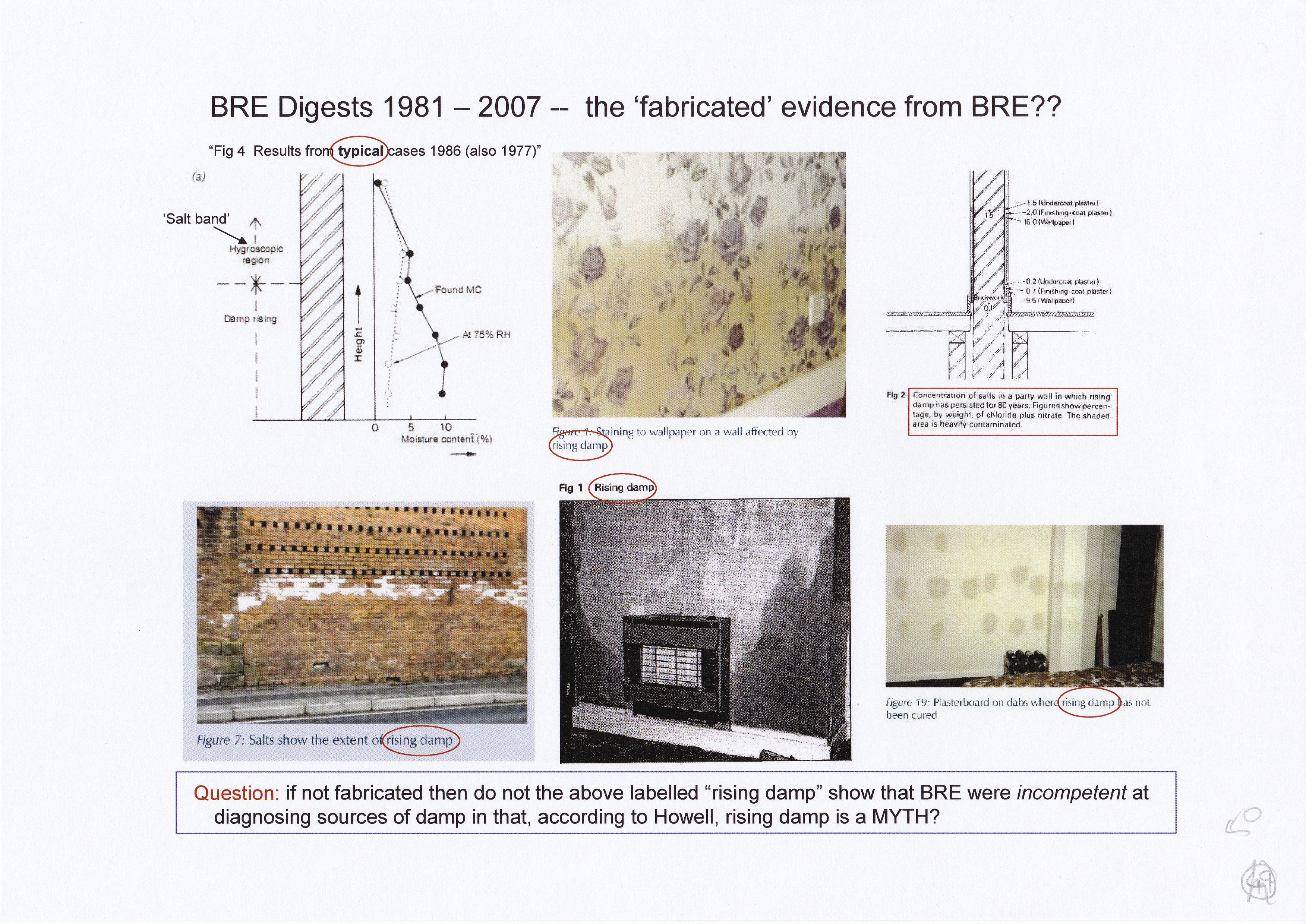
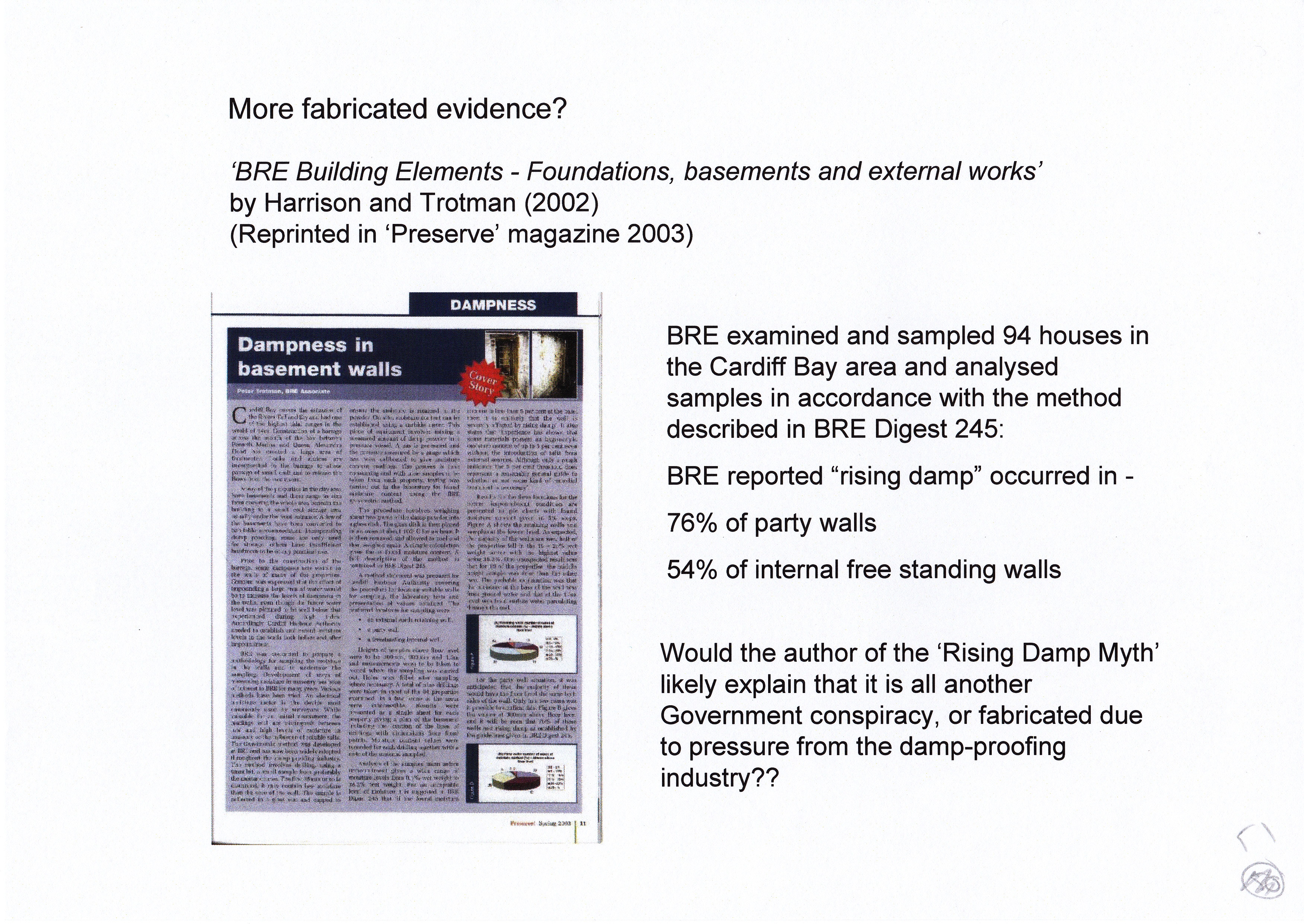
- How did Sharpe and BRE manage to develop tests and publish “-many papers, reports and digests on the subject” for years including Digest 245 (and earlier TIL 29) for diagnosing rising damp, about something they had never found out? (also note the author of ‘The Rising Damp Myth’ describes the Digest as “landmark” and the “definitive official view of the diagnosis of rising damp”!!)
- Who forged and labelled the photos and data in the Digest? And who fabricated the whole story in the Digest and other BRE papers and publications over such a long period (OVER 40 YEARS) – and still going?
- And, of course, what Government Departments authorised the funding for the BRE research, publications and their circulation over many years knowing that resulting publications by BRE where fabricated?
And from the RICS:
Jeff Howell tells us that, “__ Bob Sharpe — was the author of many papers, reports and digests on the subject, including the landmark BRE Digest 245*, which presented the definitive official view of the diagnosis of rising damp.”
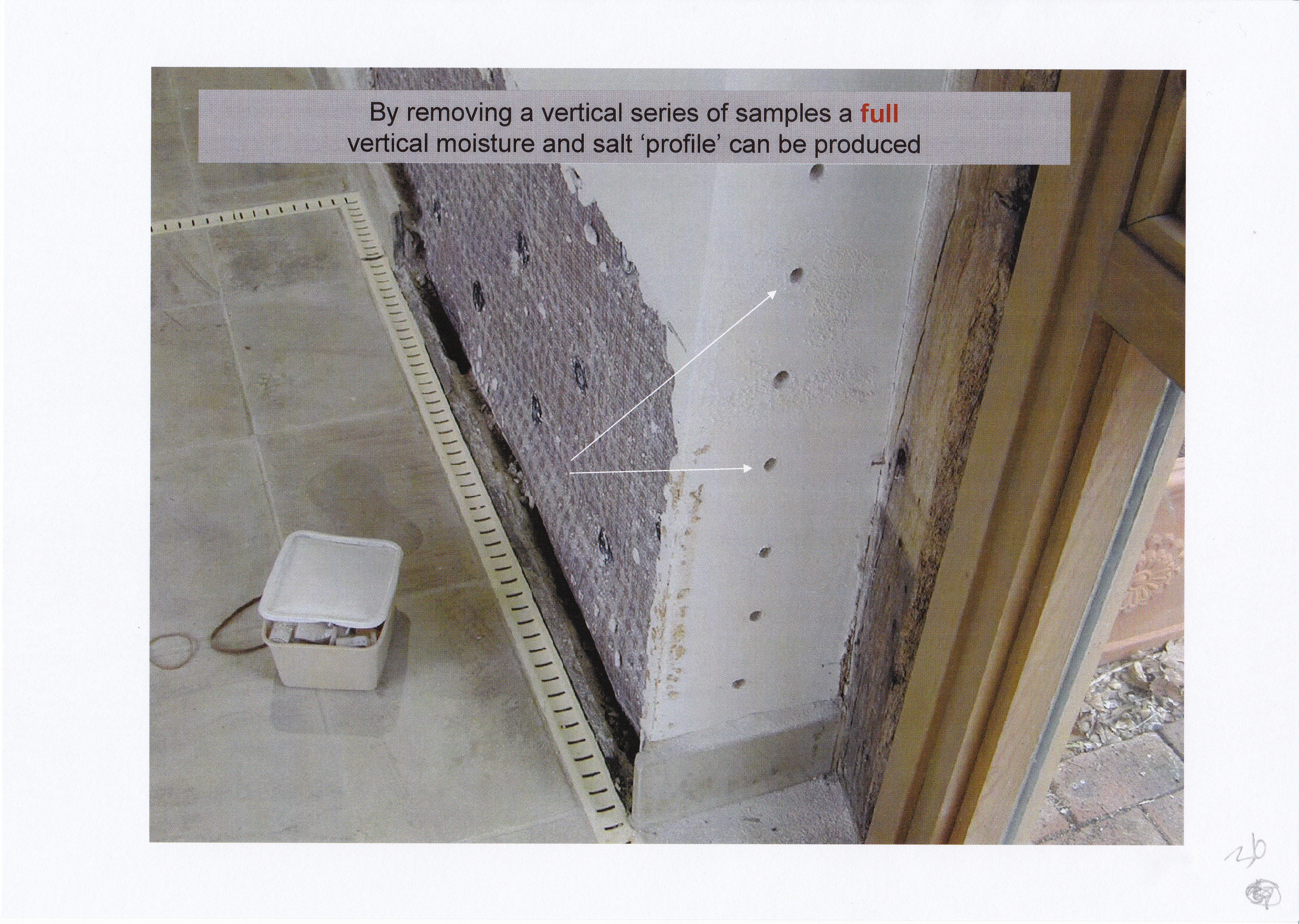
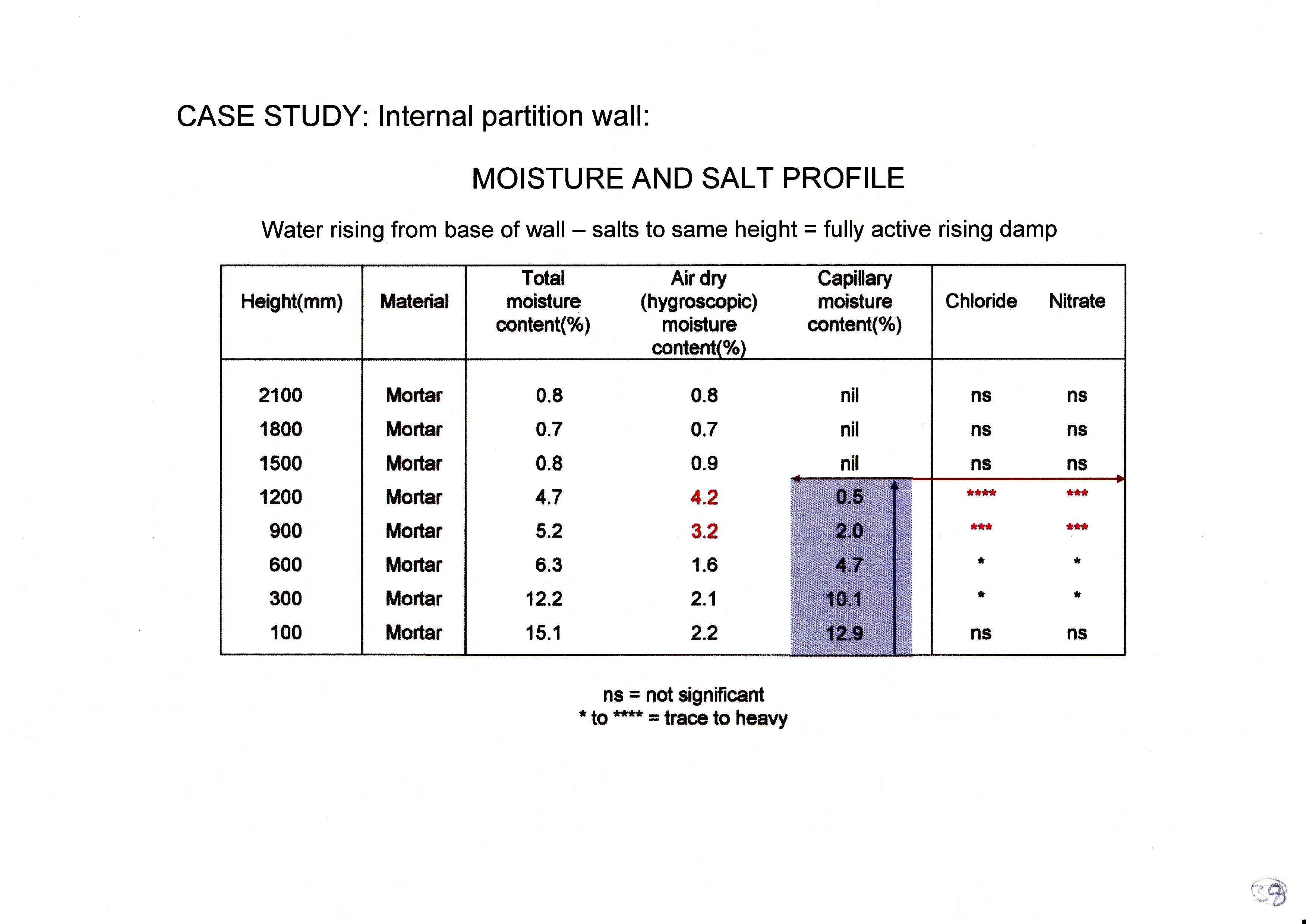
* The diagnosis described in the Digest is based on destructive testing and lab facilities to produce vertical moisture profiles of 6-8 samples per profile, to determine the distribution of water (hygroscopic and free in each sample). In essence this is the only definitive method of diagnosing rising damp.
So in a statement from Stephen Boniface, Chair of the RICS Building Surveying Faculty, recorded in the book, Boniface reports, inter alia, “-I and others within the RICS have been lecturing for years now that rising damp is misdiagnosed in over 90/95% of cases —“ [so he says 5/10% are correctly diagnosed – but he’s previously stated rising damp is a myth!]
Given that to positively identify rising damp it requires a combinations of destructive sampling and laboratory facilities, one must ask on what objective evidence does Boniface and the others base this statement given that it is highly unlikely that they have sampled and analysed anything like sufficient properties (if at all) to objectively evaluate different forms of dampness to draw that conclusion.
Boniface’s figure is pure conjecture with no substantive validation provided!
Yet another good ‘story’?
In ‘The Rising Damp Myth’ the Author states that at Audley End in Essex, “Drilled samples shows that the wall was wet, and with the pattern of moisture distribution – wetter at the bottom and with a band of salt staining half way up it seamed to bear all the hallmarks of being affected by rising damp”
He continues, “The Building Research Establishment thought that had found rising damp in the boundary wall, but once it was covered with a tarpaulin to keep the rain off, it dried. “and” – The “rising damp” had been nothing of the sort, and the wall had simply been getting wet from the rain.”
[Note: Howell states that BRE “— thought they had found rising damp –“!!
But previously he extols BRE for producing the, “— landmark BRE Digest 245, which presented the definitive official view of the diagnosis of rising damp.”
Fact:
BRE had fully identified rising damp in this wall by analyses. They found the distinct ‘salt band’. (If it was just rain penetrating then from where did the salts and the ‘salt band’ originate in the lower part of the wall?)
During the long drought of 1984 the ground water dried out as did the wall – rising damp did not recur even through BRE wetted the ground.
Note: again, the version of events described by the Author suggest that BRE were not competent at identifying rising damp even after all their years at work in producing Digest/papers on the subject, and notwithstanding he states that, “- Bob Sharp was the BRE’s top expert on dampness in buildings.!
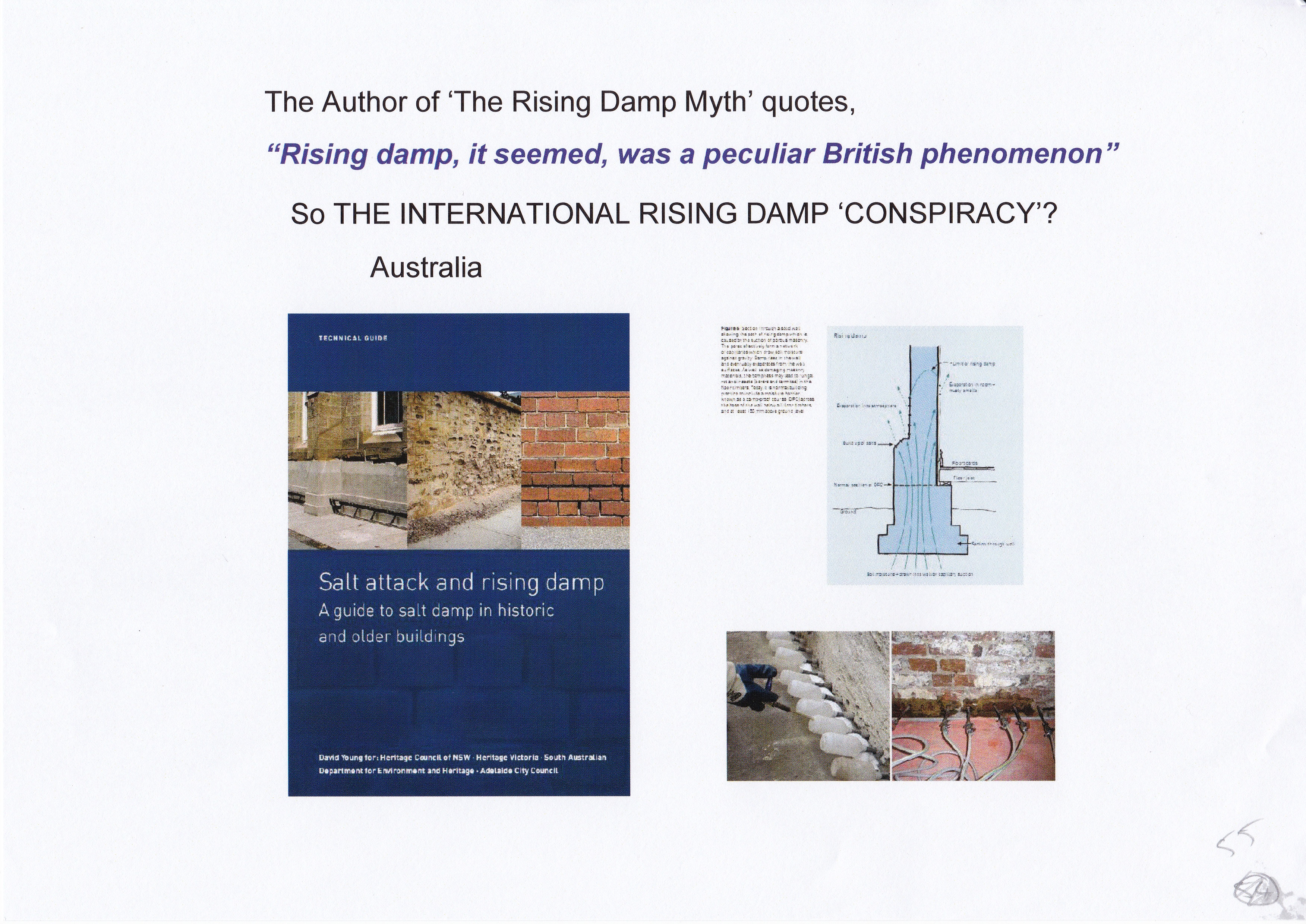

Finally, a full technical review of Rising Damp has recently been published
‘A review of Rising Damp in Buildings’
Dr Zongyi Zhang
Advanced Polymer and Composites (APC) Research Group
University of Portsmouth
A review contains over 50 worldwide references to
Rising Damp in Buildings
British Standard 6576:2005:
‘Code of practice for diagnosis of rising damp in walls of buildings and installation of chemical damp-proof courses’
The Author of ‘The Rising Damp Myth’ quotes the following:
“Bob Sharpe told me that there were two main reasons why the BRE was under pressure to produce rising damp in the laboratory.——.
The other reason was to contribute to the writing of British Standard 6576. The British Standard committee for this purpose included representatives from the major damp-proofing companies, who had themselves been unable to reproduce rising damp under laboratory conditions.” (my note: yes they did!!)
BS Committee responsible for BS 6567:
Association of Building Engineers
Autoclaved Aerated Concrete products
Brick development Association
British Board of Agreement
British Masonry Society
British Precast Concrete Federation
British Wood Preserving and Dampproofing Association
Building Research Establishment
Concrete Block Association
Eurisol – UK Mineral Wool Association
Institution of Structural Engineers
Mortar Industry Association
National House-Building Council
Office of the Deputy Prime Minister (Building division)***********
Royal Institute of British Architects
Stone Federation Great Britain
It is unreasonable to have one representative out of 16 from such an industry for a British Standard on rising Damp and damp-proofing!
** It also begs the question why would a group of such eminent and knowledgeable organisations, including BRE, RIBA, experienced in the built environment, gather and conspire and fabricate a British Standard (in 1985 and 2005) about a matter that is, according to Howell, a complete ‘myth’ and doesn’t exist??
Review and conclusion:
Based on practical and supplied evidence from a large number of sources,
Including peer-reviewed institutions:
- Rising damp is a well understood and identified feature which can occur in some buildings – it is a FACT, not a myth, and NOT originated or perpetuated by the UK damp-proofing industry
- Rising damp has some unique features which can be readily diagnosed using basic and authoritative analytical methodology
- Rising damp does NOT affect all houses without physical damp-proof courses
- ‘Rising damp’ has been observed and reported from at least the early 1800’s, ie for nearly 200 years
- Rising damp is well recorded in Australia, Belgium, Denmark, Hungry, France, Italy, Spain, indeed, across Europe, South Africa and the USA, all of which have produced authoritative peer-reviewed publications on this subject. It is not solely a UK problem!
- Electrical moisture meters are extremely useful as an aid in diagnosing dampness and associated problems (hygroscopic salts) provided they are used intelligently and their limitations and performance well understood.
And the ‘Rising Damp Myth’ by Jeff Howell?
- Very poorly researched – oblivious (or massive selective amnesia?) of authoritative worldwide peer review publications/investigations undertake by qualified scientist/engineers, and evidence of rising damp and its history.
- Very poor science (where it even appears) and failure to understand it; no objective rigor to his ‘investigations’.
- Non-supportable anecdotal evidence and grossly misleading ‘facts’ – some are nothing short of ludicrous and illogical.
- Highly likely fictitious conversations/situations not consistent with publications/known history.
- Lack of validation of so-called ‘facts’. Misquoting to support a ‘story’
- Overall, the publication appears to reflect the author’s poorly research work in an attempt to disprove, for some reasons unknown, a well review, obvious, and a proven and readily diagnosed phenomenon recorded for at least nearly 200 years. His attempt to support his self proclaimed ‘myth’ by some ludicrous, illogical and decidedly misleading ‘facts’ is simply incomprehensible.
Thanks to Graham Coleman of Remedial Technical services for allowing me to use this, Graham can be contacted on his website www.buildingpreservation.com
TicTok
TikTokhttps://www.tiktok.com › @complet…Complete Preservation (@complete_preservation)
YouTube
https://youtube.com/@completepreservation
https://instagram.com/complete_preservation?igshid=OGQ5ZDc2ODk2ZA==
https://www.linkedin.com/in/ross-charters-85883b52
Facebookhttps://www.facebook.com › compl…Complete Preservation | Trowbridge


 Welcome to Complete Preservations blog
Leave a comment