

An experienced damp investigation surveyor will carry out an internal inspection of the property, and also an external inspection. On the external inspection survey they should be looking for possible problems relating to the internal problems and any other obvious defects. One of the most common problems is high external ground levels where the damp proof course has been bridged, or potential for rainwater to splash over the damp proof course.
The below diagram shows what bridging of the damp proof course looks like, caused by high ground levels.
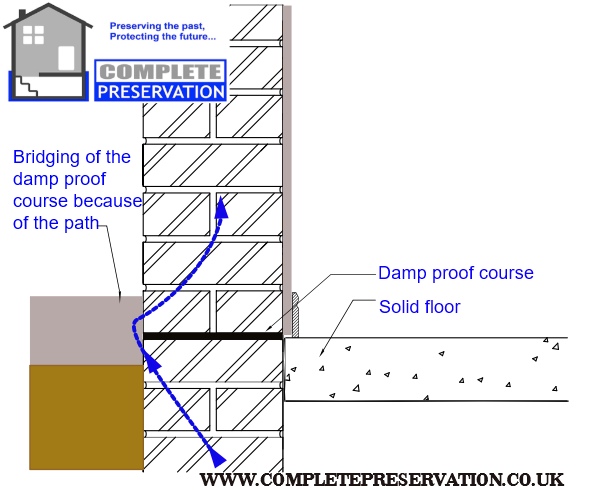
By simply lowering external high ground levels, this will allow wall base evaporation, to help control rising dampness.
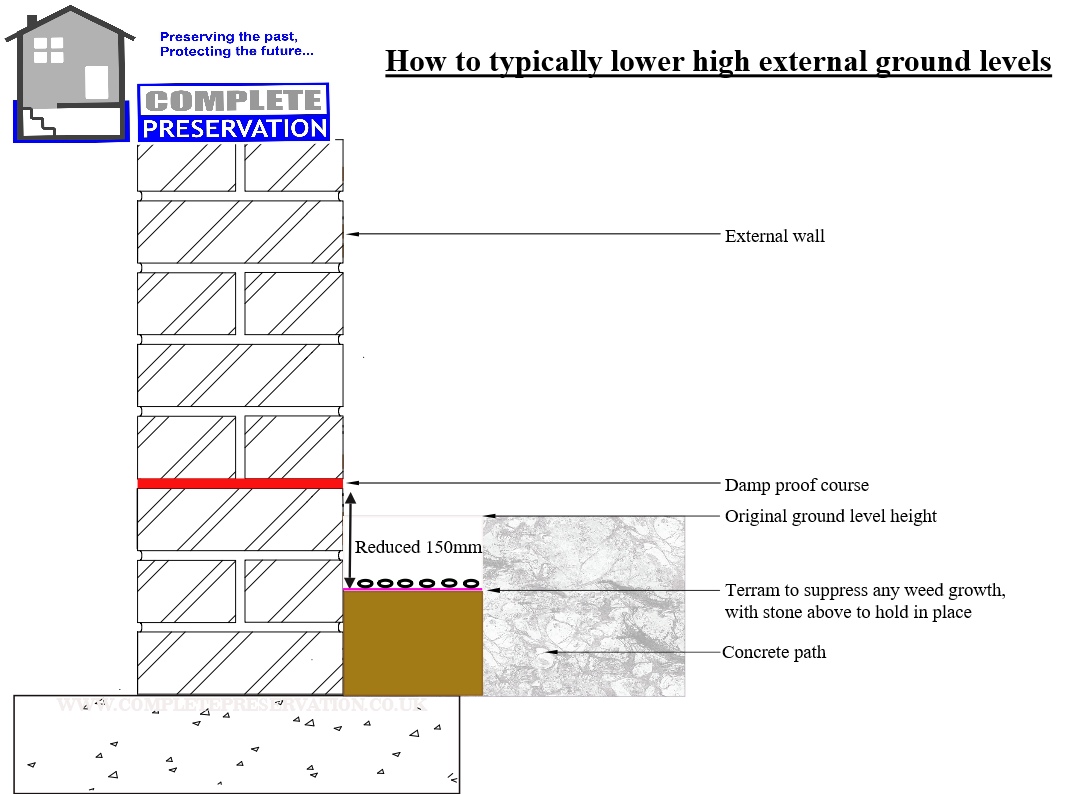
External ground levels ideally need to be lowered 150mm below the damp proof course. Mass ground excavation isn’t necessary, simply cutting out a channel and using terram to supress any weed growth and pebbles is a simple procedure, and I have found this procedure to be successful on all of my damp repairs. This is something we have been doing now for over 20 years, so I can say this with confidence.
Complete Preservation carry this type of work out normally using the typical drawing below.
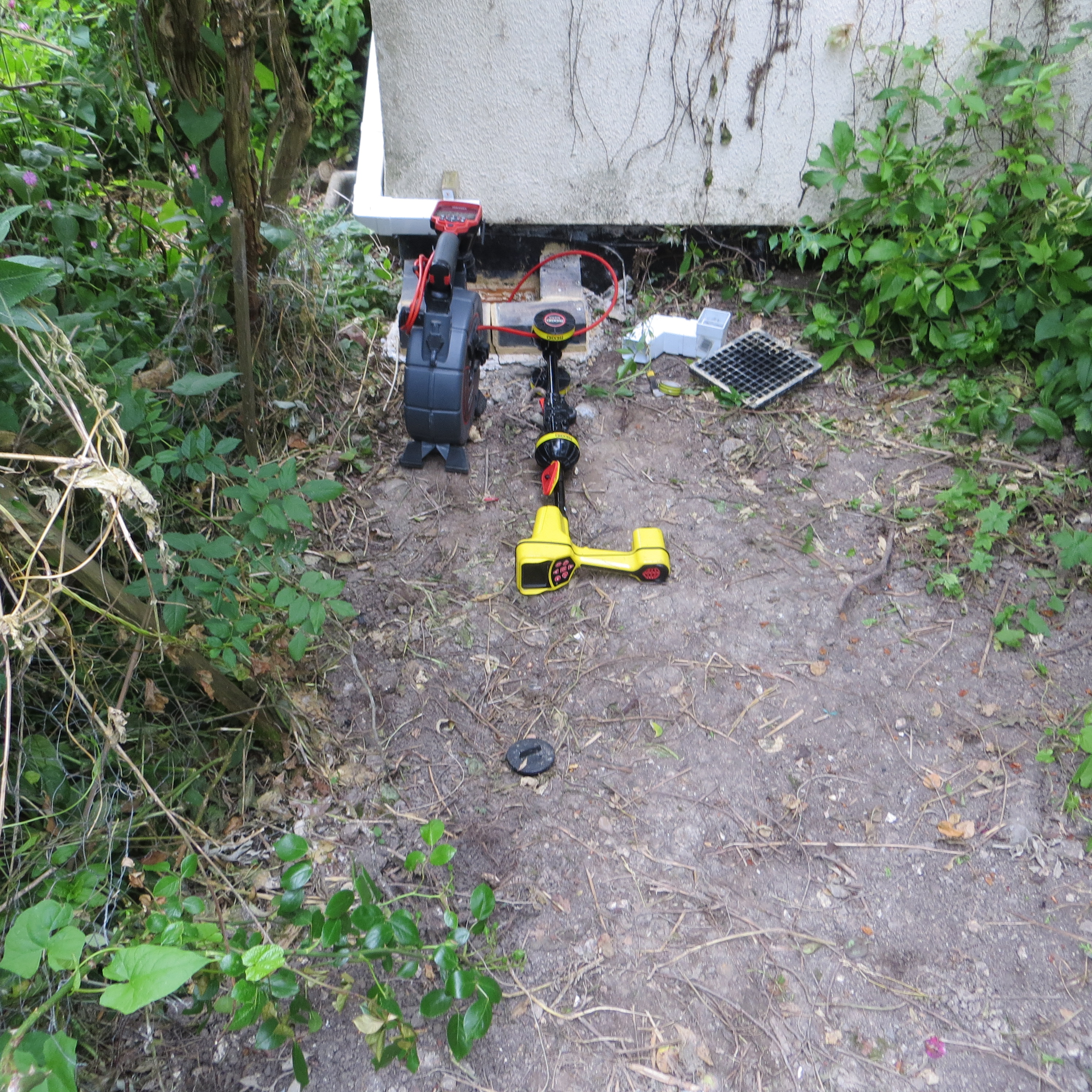
Before any cutting into the ground is carried out it is imperative to use cable avoidance detection equipment.
We use the below Rigid SeekTech SR-20, along with our rigid drain cameras. Our drain cameras also have a sonde, so we can be very precise when cutting or breaking up the ground.
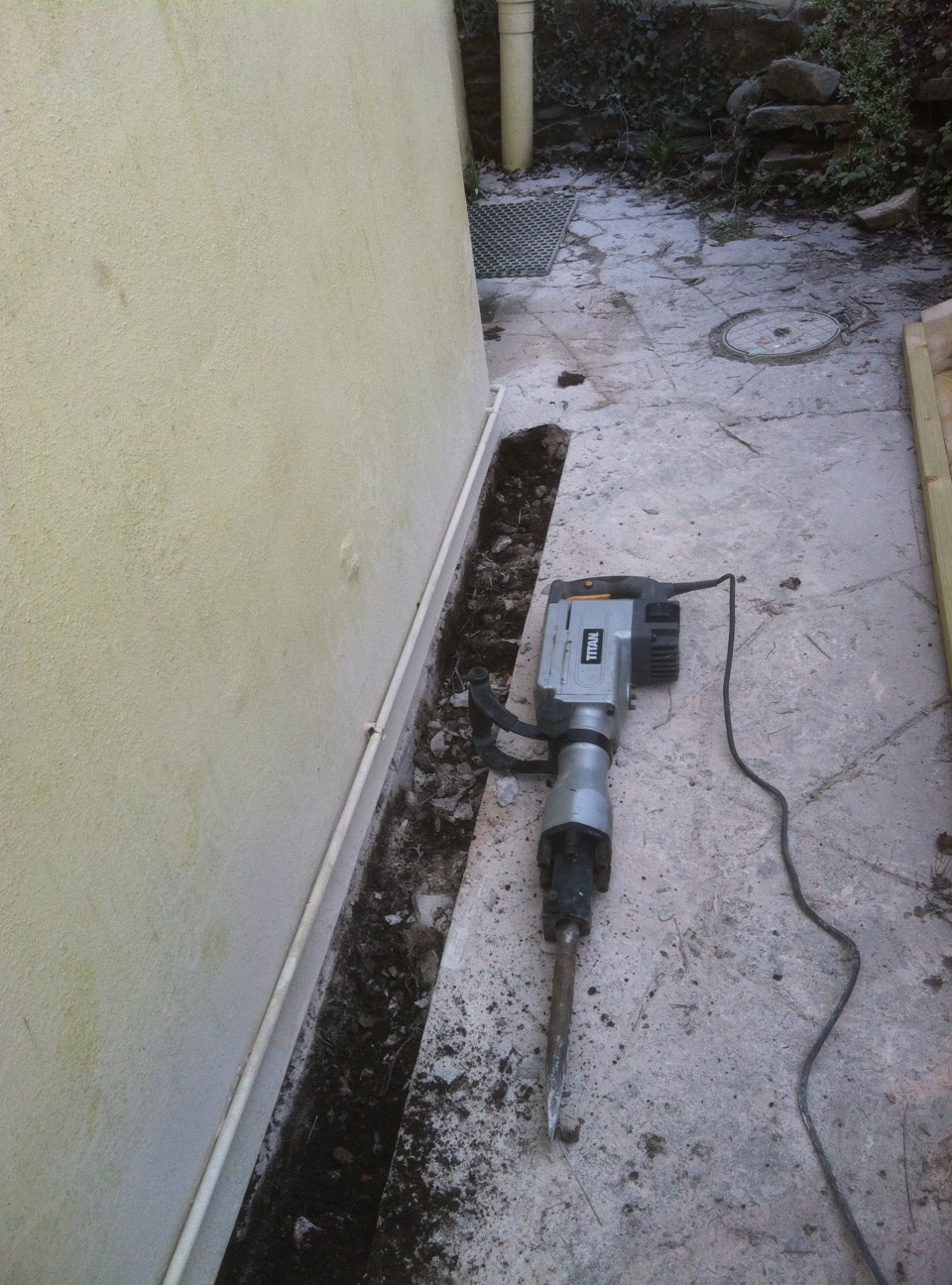
We use specialist Hilti dust extraction systems connected to professional Hilti cutting equipment to minimise dust.
Below are some pictures of cutting and breaking out the concrete.
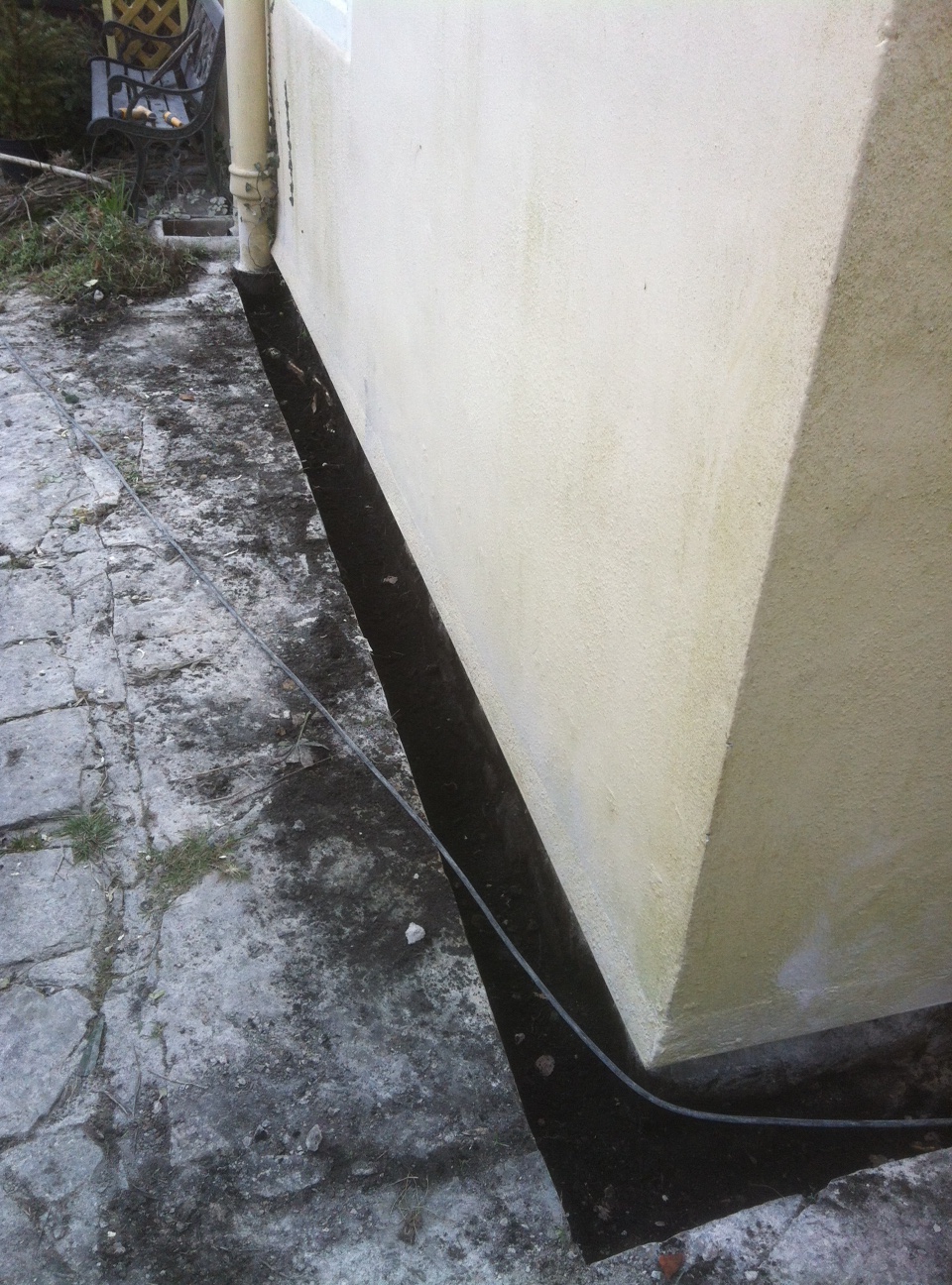
Geo-membrane is placed above the earth to stop weed growth and golden gravel is poured on top
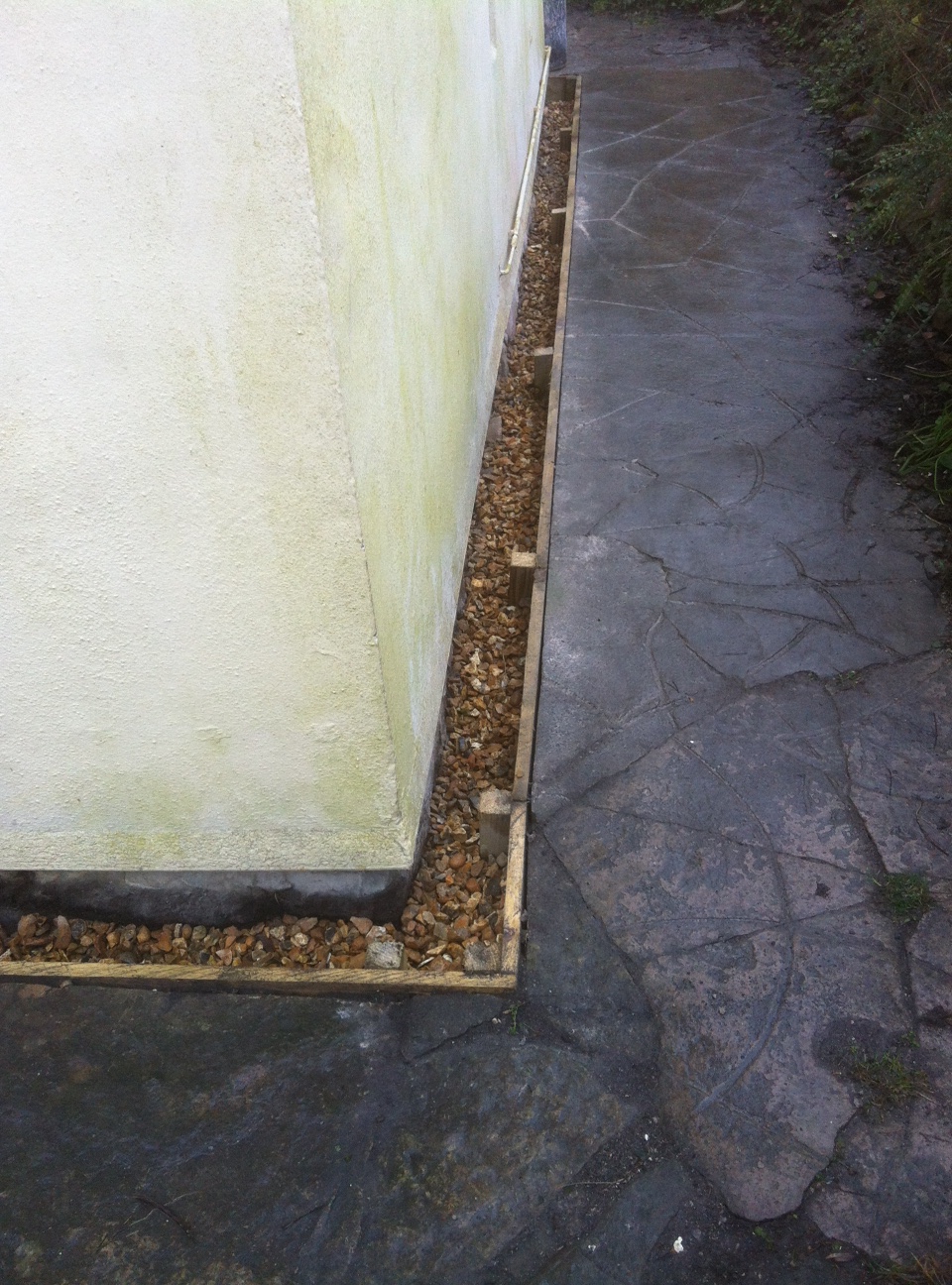
The picture below shows the level of what the ground level used to be before we lowered it, the sub floor vent was blocked which we cleared out.
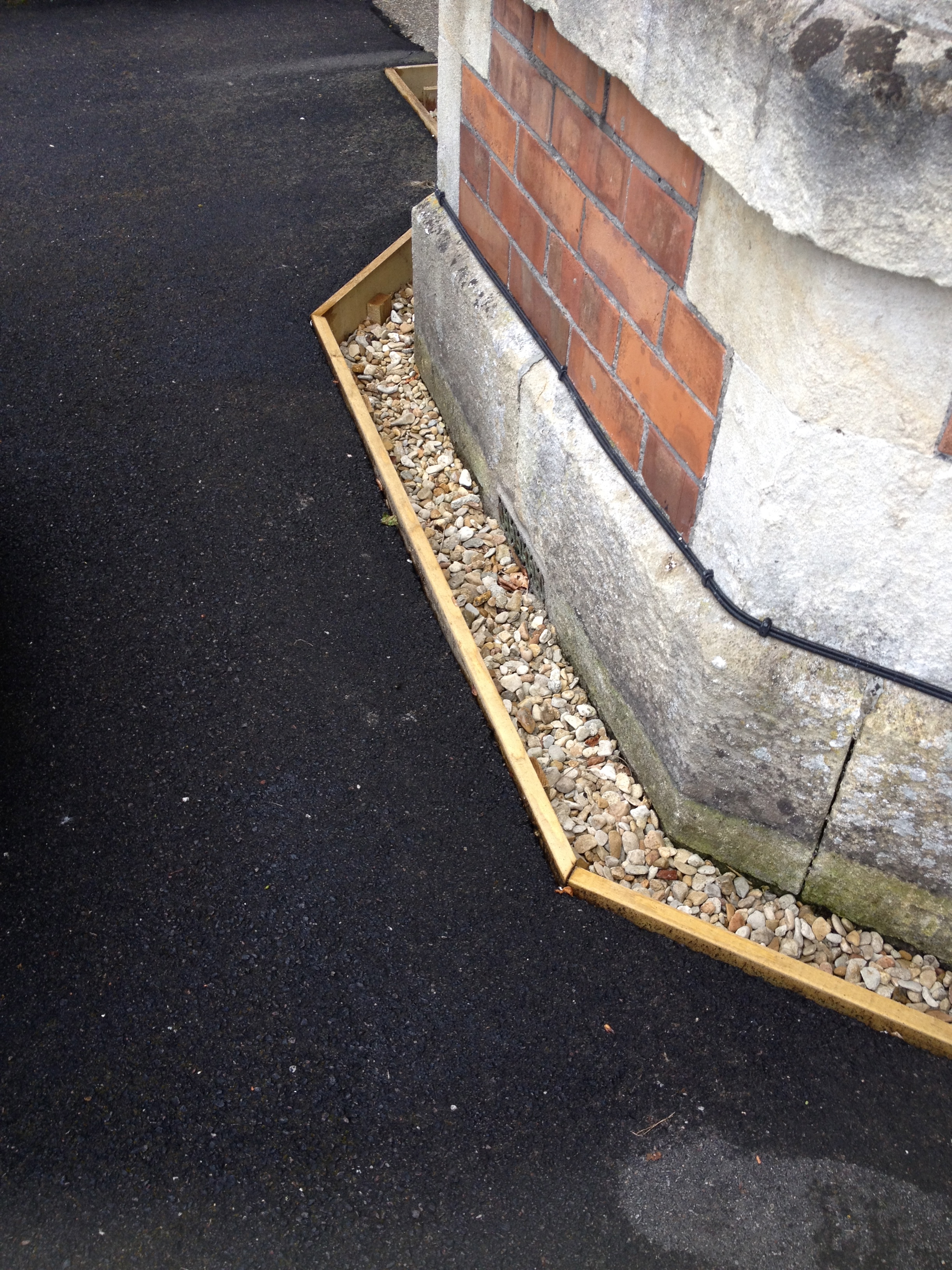
This is very effective in helping evaporation of rising dampness at the wall base.
Often people can presume that because the ground level is slightly high reducing this will fix the issue; however if hygroscopic salts are present in the plaster finish lowering the ground levels will not remove the hygroscopic salts. Gravimetric analysis can confirm if moisture and/or hygroscopic salts are present; this is a service we also offer.
A damp wall takes time to dry out, as a general guide the drying rate is given as 1 month for every 25mm of wall thickness (BRE,”Drying out of buildings”) A 230mm thick wall will take approximately 9 months to dry. However, the drying processes depend on many conditions, ventilation and the type of masonry, so drying may take considerably longer than anticipated.
When ground levels are lowered it is also highly likely that a small amount of lime pointing will also be necessary at the base of the wall.
Ground levels should be lowered by a competent person or you should take advice from a structural engineer in order to ensure the structural integrity of the building isn’t compromised.
If you would like a survey, and price to lower external ground levels if they are high, please contact us on enquiries@completepreservation.co.uk We can also carry out the plaster sampling internally following the methodology in BRE DIGEST 245 to confirm if hygroscopic salts are present and the plaster will need replacing.
Please see the video of Ross Charters explaining how to lower ground levels, and also some tips for you.
Follow us on our social channels where you can get free tips on damp and building defect issues, and you can engage and get your questions answered.
TicTok
TikTokhttps://www.tiktok.com › @complet…Complete Preservation (@complete_preservation)
YouTube
https://youtube.com/@completepreservation
https://instagram.com/complete_preservation?igshid=OGQ5ZDc2ODk2ZA==
https://www.linkedin.com/in/ross-charters-85883b52
Facebookhttps://www.facebook.com › compl…Complete Preservation | Trowbridge

 Welcome to Complete Preservations blog
I’ve had a survey carried out on a Grade II listed building. The survey states that the ground level around the outside of the house needs to be reduced to help reduce damp. As the building was built in 1850 and has no DPC I can’t see how this will help!!
Hi Kevin,
This is a sensible approach to allow evaporation at the base of the wall, also check for any other external defects especially when its raining. You may also wish to have a drain survey, if you continue to have dampness problems a survey should be carried out to BRE Digest 245.
This is what I think I need to have carried out to stop this rising damp issue I have. Do you do damp surveys in Devizes? I will need the whole house surveyed and a CCTV drain survey which I see you also do.
Hi Dean, I cover Devizes for damp surveys. Please email your details and I will ring you to discuss.
Ta
Hi. Great article and something I think my house will benefit from. The problem I have is that the DPC appears to be only one brick above where the brick foundations start. The layer below the brick line with the dpc and the layer below that are stepped out (imagine how a pyramid looks). It’s a Victorian semi I think (not sure on the date) Can this still be effective in this instance? Appreciate it’s hard to describe (hence the bad diagram!). Could do with some advice please! Thanks
|
| __ dpc
_|
_|
|
Hi Chris, thanks for the kind comments. Lowering ground levels along with checking drains is a great help with damp issues. Unfortunately I cant really give advice without actually seeing your issue myself. sorry bud. Have a look on my Youtube for tipshttps://www.youtube.com/watch?v=kLU2v84-bDU&list=PLcSNFcNIIrlyETlQ7qY54eMVRUKKf8idq
Fully appreciate it’s hard to convey using the written word. I’ll take a look at the video. I’ve been watching most of them for the last day or 2. Great content. Nice to see a common sense approach to these things. So much BS out there.
Appreciate you taking the time to respond.
Regards
Thanks Chris 🙂
Hi Ross
I was wondering where does the water sit once it goes down the trench? Is it OK to leave it there? Or it should be taken away with a drain.
Thank you.
Ben
Hi bud, its fine as it will evaporate over time. But make sure you don’t direct water to run off from a path ideally. If it does do this perhaps put an edge on the concrete to divert away…hope this helps 🙂
This is just what I need, and looking at your videos on TikTok and YouTube I think it would best to get you to look at our damp issues.
How much do you charge for a damp investigation please?
Hi Bob it all depend s on what needs looking at that, the size of the property and suspected damp areas. Drop me an email enquiries@completepreservation.co.uk and we can discuss 🙂
Our ground levels have been reduced now for over 2 years and the wall plaster looks no different. Could this be hygroscopic salts damp staining the plaster?
Hi Janice, it could be. You can send me samples of mortar in and I can tell you exactly what the issue is. £50 plus vat per sample, and if its of interest email me enquiries@completepreservation.co.uk
What is the average cost per meter to lower concrete like this
Thanks
Hi Jane, I personally don’t price jobs like by the meter. Most trades price per what they think they can do in a day, plus any other additional costs added. hope this helps 🙂
How much should I expect to pay for the re point of wall with a mortar like lime
Thanks
Hi David,
it depends really as everybody prices differently. Some people work in a meterage, whilst others work on a day.
Where ive been doing this for years I know how long it takes, material prices, and my labour charge along with getting rid of any debris gets me the price. It is quite a lot of work though, so I wouldn’t expect anybody to do it cheap
Hope this helps 🙂
Thanks for useful articles – We have high ground levels on two sides of our house, where the previous owners have built up patios right to the level of the DPC. Would it help to also include perforated pipe run towards a drain in any channel/trench, like a french-drain, or is there not much additional benefit?
(Also, do you cover the west sussex area out of interest!?)
I have render that runs to the gravel – I’m not sure if render was put their by previous owners for protection – what do you advise? Survey says to lower ground levels and add bell cap strip as there is no gap from gravel and render at the moment. Will this mean digging up all garden to move it 6 inches down? Is it worth removing the render completely and letting it breathe with the gravel staying where it is?
Sorry ive only just seen this… I do a video on YouTube explaining this, its an old White House, and it shows how I detailed https://youtu.be/eUz26YqlyJ8
sorry ive just seen this, watch this video it should help you 🙂 https://youtu.be/eUz26YqlyJ8
My garden slabs are near enough level with the top of dpc. There is a 8 inch gap between the slabs and the house. And the depth is 2 bricks deep in this 8 inch gap. We aren’t having any issues, but should I take action now and lower the whole area of slabs? Or is this ok. Or should I fit a perforated drain along the house connecting to the drain pipe covered with gravel just below the dpc.
Having recently had a damp survey carried out by Plumb Stone surveyors, this is something that needs to be carried out to allow the damp wall to dry. Is it really necessary to test for hydroscopic salts though?
The reason of the post is to show best practice, and in my opinion following best practice allows me to give my clients the correct advice, and most importantly the costs involved. So if there is salts in the plaster, it is likely the plaster will need replacing. if it does all need doing it would be cheaper to do everything in one go rather than separate jobs. Probably best to read the report and see if it is mentioned, or your terms and conditions prior to the survey, or just ask the surveyor why they didn’t do it. most damp surveys are sold as a non invasive survey, so would expect that’s what you have agreed to.
It was a very expensive damp survey; so I’m befuddled as to why this wasn’t done.
Can I email you the report and pay you for your advice please?
Tia
Sarah
Hi Sarah, you can email the report to enquiries@completepreservation.co.uk
Hello,
I found your video quite enlightening. A few months ago, we invested significantly in damp-proofing our property. However, we have recently discovered that our main water supply was damaged by a fence post, which raises the strong possibility that this was the actual cause of the damp issues. I noticed in your video that you mentioned salt tests and render samples, which were not conducted during our damp-proofing process. Furthermore, there was no inspection of below-ground drains, and plumbing pressure tests were omitted as well. This was a significant financial commitment for us, and we even borrowed money to cover the cost.
Is it possible for you to conduct tests to determine the true cause of the damp issue, and ideally, we would like to explore the possibility of seeking a refund from the damp proofer? Additionally, I’d like to confirm if your services extend to Trowbridge.
Thank you.
Hi im glad you liked the video. Yes, I offer all tests you mention to find out the root cause of rising damp issues. I can produce a report detailing best practice and also what actual works are needed to repair the issues, or what should have been done. I do cover Trowbridge as that’s where I live 🙂 Drop me an email at enquiries@completepreservation.co.uk with report, and some images initially please…..